

REVIEW · SKIP THE LINE
Coimbra: A Local’s Tour of the University + Skip-the-Line
History comes alive on Coimbra’s hilltop. This 90-minute tour brings the University of Coimbra’s grand rooms and odd student traditions into focus, with skip-the-line entry to the historic complex and the Biblioteca Joanina. I especially like the access to the library, which many shorter university visits leave out, and the chance to hear personal stories from guides such as José, Rogério, David, and Jorge, several of whom have studied at the university themselves. The main drawback is the stair-heavy route, which is not suitable for wheelchair users or people with mobility difficulties.
The price is $76 per person, so this is not the cheapest way to see the university. Still, the fee includes the guide and entrance ticket, and the added context makes a real difference in rooms that can otherwise feel like a string of ornate interiors. Library entry is carefully timed for groups of 50 or fewer, so your start time may shift slightly.
In This Review
- Key points to know before you book
- Starting at Dom Dinis and the Paço das Escolas
- The Porta Férrea and its royal symbols
- Inside the Biblioteca Joanina, Coimbra’s grandest room
- Beneath the library, the Prisão Acadêmica
- The Real Capela de São Miguel and its blue tiles
- The Sala dos Capelos, where academic ceremony continues
- Ending at the Via Latina above Coimbra
- What the local guide adds
- Is $76 a fair price?
- Timing, stairs, and practical planning
- Who should book this university tour?
- Should you book the Coimbra University tour?
- FAQ
- Where does the tour begin?
- How long does the experience last?
- Is entrance included?
- Does the tour include the Biblioteca Joanina?
- Is skip-the-line entry included?
- What languages are available?
- Can I book a private group?
- Is photography allowed?
- Is the tour suitable for wheelchair users?
- Can I cancel for a refund?
Key points to know before you book
- The Biblioteca Joanina is the star attraction: Expect gilded woodwork, painted ceilings, rare books, and the famous insect-eating bats.
- You enter through the Porta Férrea: This 1634 triumphal arch introduces the university’s royal and academic story.
- The tour covers more than pretty rooms: You visit the former academic prison, the chapel, ceremonial hall, and Via Latina.
- A former student can add useful local color: Guides including José and David have brought university rituals, Portuguese history, and student life into the tour.
- The route includes stairs: This is a poor fit for wheelchair users and may be tiring for anyone with limited mobility.
- Early times can be smart: A morning visit may help you avoid the busiest part of the day and gives you more time afterward to explore Coimbra.
Starting at Dom Dinis and the Paço das Escolas
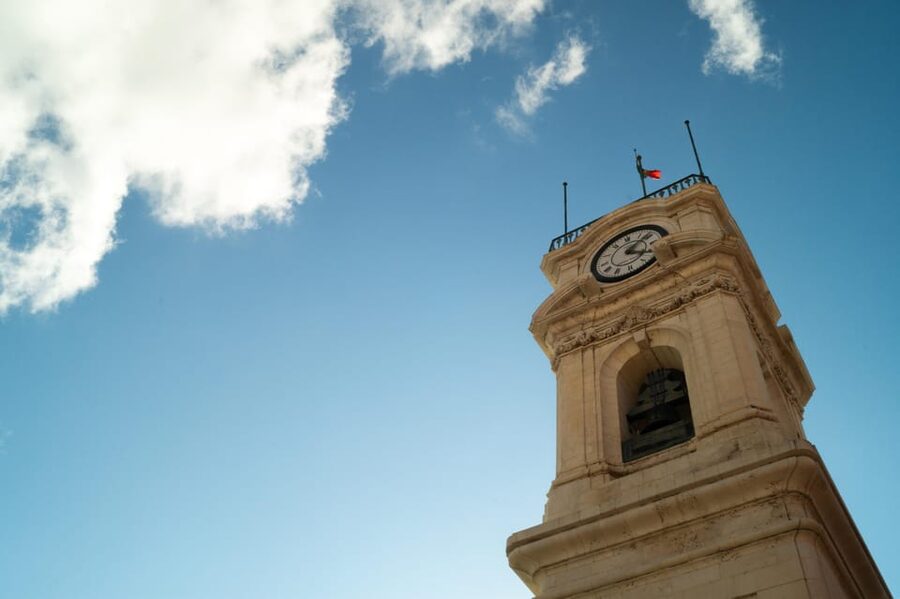
Your meeting point is outside the iron gate, in front of the Porta Férrea, near Dom Dinis. The guide waits there, so look for the person standing outside the iron door rather than heading straight into the university courtyard.
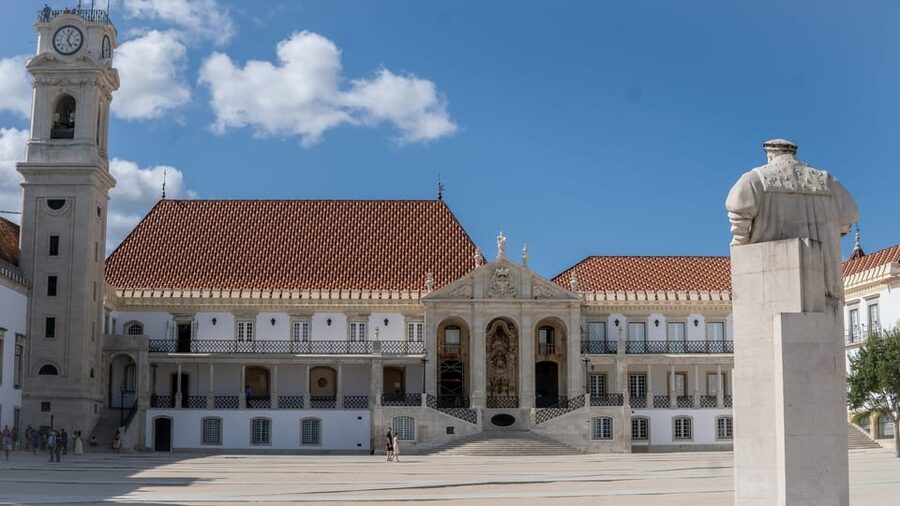
The tour begins at the Paço das Escolas, the historic core of the University of Coimbra. The university moved from Lisbon to Coimbra in 1537, and this former royal palace became the center of academic life. That setting matters. You are not simply walking through a museum. You are entering a working university whose buildings grew out of royal power, religious practice, discipline, and education.
The courtyard is framed by grand stone façades and open views over Coimbra. Your guide helps connect the architecture to the university’s wider story, including the role of Portuguese kings and the changing place of education in national life.
I would give yourself a few minutes before the official start to take in the setting. The Paço das Escolas is one of those places where a quick glance misses the details. Once the guide begins, you can look more closely without worrying that you are missing the main explanation.
A few more Coimbra options side by side
- Coimbra: Live Fado Show with Glass of Port Wine
★ 4.7 · 998 reviews - University of Coimbra guided tours without queue
★ 5.0 · 518 reviews - Guided tour of the University and city of Coimbra.
★ 5.0 · 377 reviews
The Porta Férrea and its royal symbols
The Porta Férrea, or Iron Gate, dates from 1634 and works as a ceremonial entrance to the university. It was designed by António Tavares and includes statues of D. Dinis, who founded the university, and D. João III, who moved it to Coimbra.
Look for the representations of the university’s original faculties. These details are easy to overlook when you are focused on getting through the arch and into the courtyard. A guide makes the gate more readable, explaining how its decoration presents the university as both a royal institution and a center of learning.
There is also a student tradition tied to this entrance. Students have been known to tie academic dress to the gate after finishing their studies. It is a small, human detail that helps balance the formal stonework and royal imagery.
This first stop is brief, but useful. It gives you the names, symbols, and political background needed for the rooms that follow.
Inside the Biblioteca Joanina, Coimbra’s grandest room
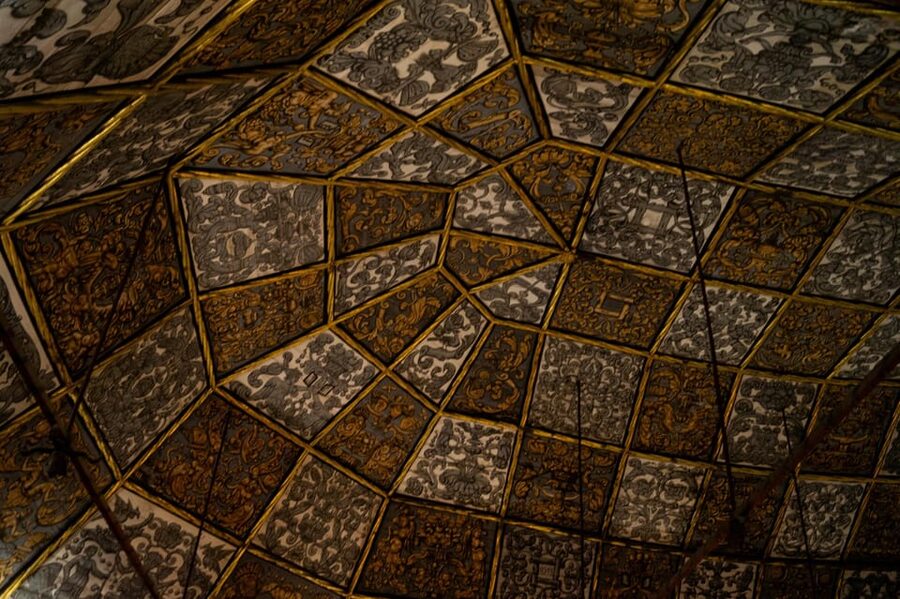
The Biblioteca Joanina is the reason I would not choose a university visit that skips the interior. Built between 1717 and 1728 during the reign of D. João V, the library contains around 60,000 rare volumes and is one of Portugal’s great Baroque interiors.
The room is rich in visual detail without being easy to absorb all at once. You will see gilded woodwork, frescoed ceilings, and carefully crafted exotic hardwoods. The decoration reflects the wealth and ambition of the period, but the collection itself is the real point. These are old and valuable books, kept in a space designed for their protection.
One of the best details is the library’s bat population. The bats help control insects that could damage the books. It is a practical bit of natural pest control hidden inside an exceptionally formal room, and it is exactly the sort of story that gives the visit personality.
The library also uses design features to help maintain suitable conditions for the collection. Your guide can explain how the building’s construction supports preservation, rather than treating the library as decoration alone.
Photography is allowed, but flash photography is forbidden inside the Biblioteca Joanina. Keep your camera ready before entering, then switch off the flash. The university limits access to 50 people per time slot, so the schedule can be adjusted if necessary. That restriction may mean a little waiting or a change in order, but it also protects the experience from becoming a packed-room scramble.
The library visit is scheduled for about 30 minutes within the overall experience. That is enough to see the major features and hear the main stories, though anyone hoping for extended quiet reading time should adjust expectations. This is a guided heritage visit, not a chance to browse the books independently.
Beneath the library, the Prisão Acadêmica
From the ornamental library, the route descends to the Prisão Acadêmica, a medieval prison under the building. The university once had the authority to discipline students who broke its rules, and this confined space shows just how separate university life could be from ordinary civic control.
The contrast is striking. Upstairs, you have gilded decoration and royal ceremony. Below, you find narrow cells and a much harsher side of academic independence. Your guide explains how students were held there and how the prison reflected the university’s special legal status.
This stop is less polished than the library, but it adds needed balance. Without it, the university might seem like an endless procession of beautiful rooms. The prison reminds you that old institutions came with strict rules and real consequences.
The stairs are important here. The tour involves climbing and descending, so you should think carefully about comfort and mobility before booking. The experience is specifically not suitable for wheelchair users or people with mobility impairments.
Same corner of the country, a different pace:
- Coimbra: Mondego River Kayaking Tour
★ 4.7 · 324 reviews - Coimbra: Guided tour with a local student
★ 5.0 · 170 reviews - Portugal dos Pequenitos entry ticket
★ 4.2 · 167 reviews - Joanina Library & Coimbra University | Private Former Alumni Tour
★ 5.0 · 135 reviews
The Real Capela de São Miguel and its blue tiles
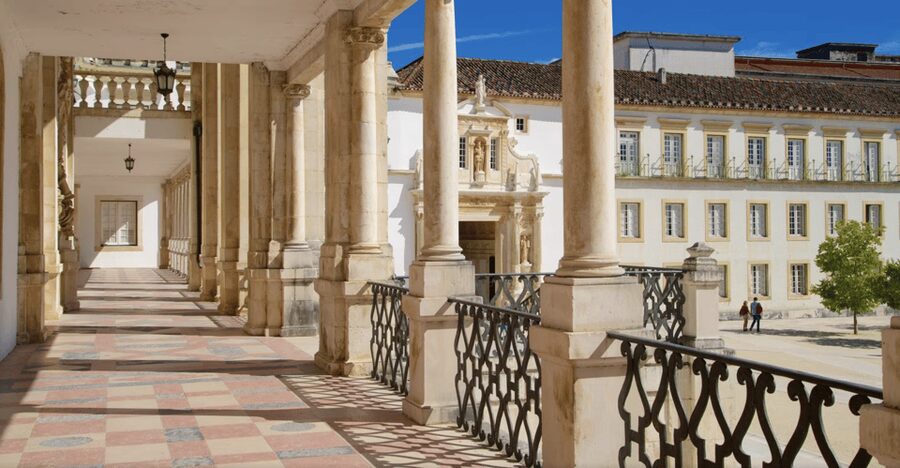
The Real Capela de São Miguel brings together older origins and later Baroque decoration. Inside, look for gilded altars, intricate azulejos, and a large organ with more than 2,000 pipes.
The chapel is still part of university life. It hosts religious ceremonies, concerts, and weddings, so this is not only a historic shell. Its continued use helps explain why the room feels more than decorative, even when it is quiet.
The azulejos deserve close attention. Portugal’s painted tiles often reward patience, and here they work with the gilded altars and organ to create a dense, highly decorated interior. Your guide can point out how the chapel’s pieces fit together rather than leaving you to take in a blur of blue, gold, and carved wood.
As in the library, photography rules matter. Flash photography is not permitted inside the Biblioteca Joanina, and it is sensible to follow the same respectful approach throughout the university’s historic interiors.
The Sala dos Capelos, where academic ceremony continues
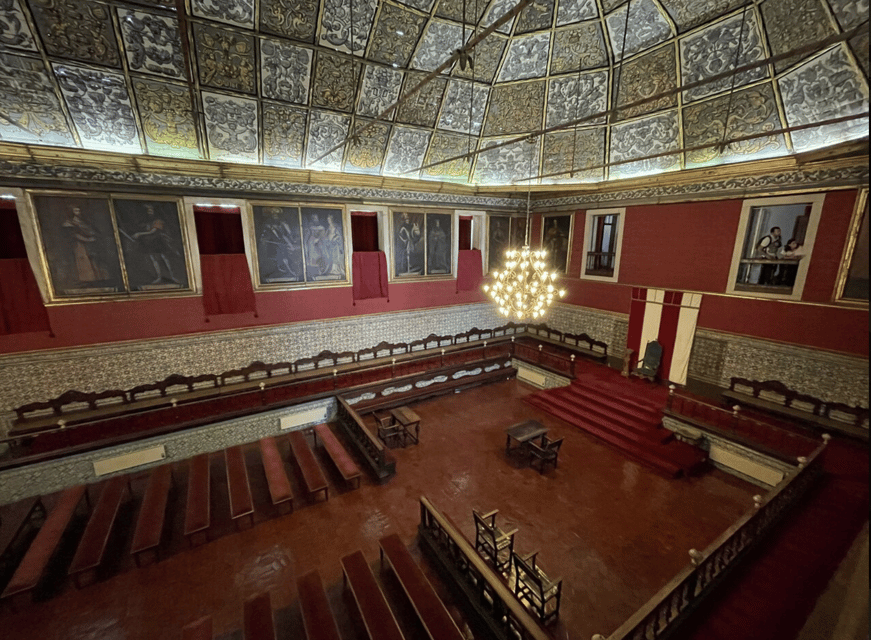
The Sala dos Capelos was once a royal throne room and is now the center of the university’s formal academic rituals. It is also one of the tour’s most impressive rooms.
Blue azulejos line the walls, the ceiling carries grotesque motifs, and portraits of Portuguese monarchs look down over the hall. The room’s appearance tells you a great deal about the university’s ties to the crown. Education here was never isolated from the country’s rulers and institutions.
The hall has hosted royal proclamations and continues to be used for doctoral defenses. That link between past and present is one of the most valuable ideas in the tour. You are looking at a ceremonial room with centuries of use, not an interior preserved only for display.
I like this stop because it gives the university a living rhythm. The library shows scholarship, the prison shows discipline, the chapel shows faith and ceremony, and the Sala dos Capelos shows academic achievement.
Ending at the Via Latina above Coimbra
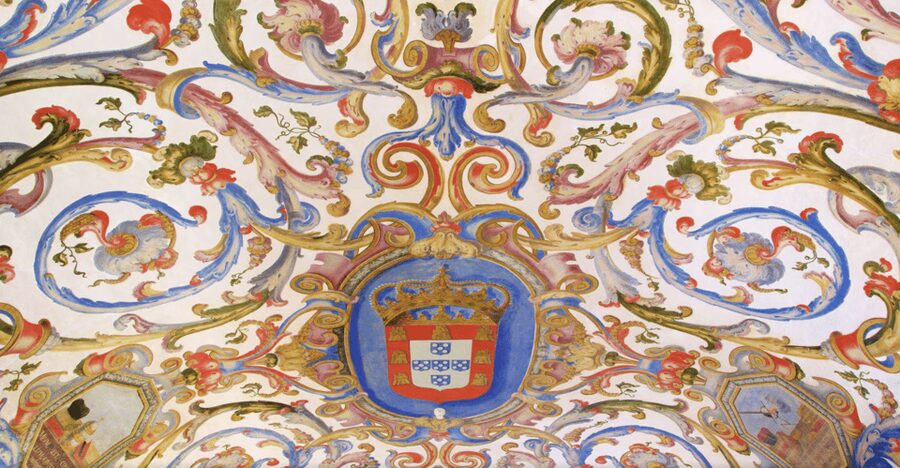
The final stop is the Via Latina, an 18th-century neoclassical colonnade overlooking the Paço das Escolas. It marks the university’s shift from Latin toward Portuguese as the official teaching language.
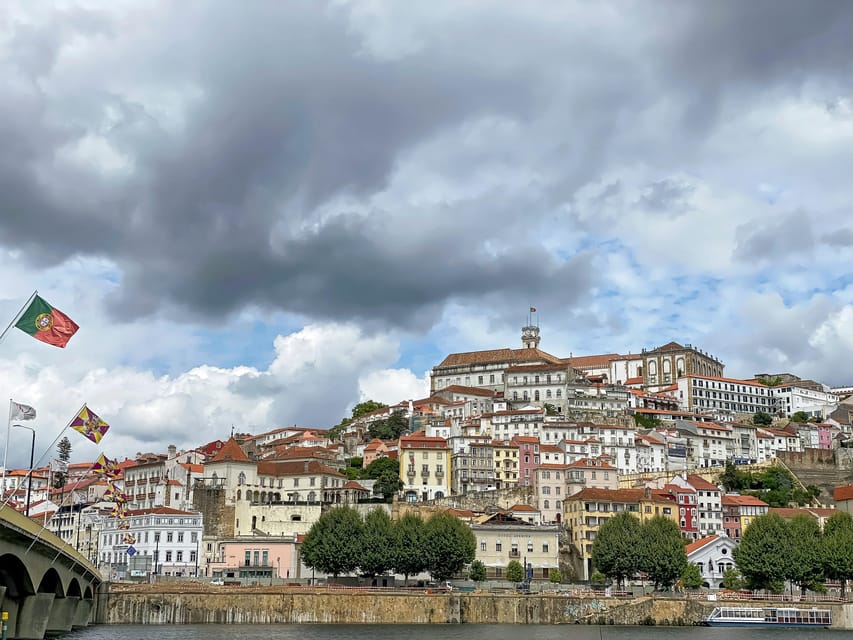
The colonnade also gives you a chance to pause after the indoor rooms. From here, you can look across Coimbra and reflect on the university’s place in the city. The view is not a separate sightseeing stop, but it is a fitting close to a route built around learning, language, power, and tradition.
The end point is back at Dom Dinis, near where the tour began. That makes the experience easy to fit into a day of exploring Coimbra’s upper town. You are not left at an unfamiliar part of the city.
What the local guide adds
The guide is the main reason to pay more than a basic entrance ticket. A self-guided visit can show you the architecture, but it may not explain the links between the royal palace, student rules, Portuguese kings, academic ceremonies, and present-day university life.
José has guided many visitors through the university with a background in its history and a strong grasp of Portugal’s wider story. Rogério has also led detailed visits, while David has been praised for explaining the city, country, and university in clear terms. Jorge is another guide associated with personal and extended visits.
You may also encounter a guide with current or recent ties to the university, including a student studying tourism. That can bring a different angle, especially when the conversation turns to student rituals and everyday university life.
The best guides on this route do not simply recite dates. They explain why a room matters, tell the story behind an unusual custom, and answer questions in a way that matches your interests. Past participants have particularly valued the humorous tales, student traditions, and stories about the bats in the library.
The exact guide is not guaranteed, so I would not book solely for one person. The consistent strength is the local and academic perspective built into the experience.
Is $76 a fair price?
At $76 per person, this is a premium short tour. The 1.5-hour duration means you are paying for focused access and interpretation rather than a full day of sightseeing.
The value improves if you care about the Biblioteca Joanina. Entrance to that library is included, and the skip-the-line arrangement can save effort at a site where entry is limited by timed capacity. Many cheaper visits may not include the library, so compare inclusions carefully before choosing on price alone.
I would see the cost as reasonable for someone who wants the university explained rather than merely photographed. It is less appealing if you prefer to wander slowly, avoid guided visits, or are mainly interested in seeing the courtyard from outside.
The private group option may also make sense for couples, families, or small parties who want to ask many questions. A standard group can still be worthwhile, especially since the route is compact and the guides have been praised for clear explanations and a friendly manner.
Timing, stairs, and practical planning
The tour lasts 1.5 hours, with about 30 minutes allocated to the Biblioteca Joanina. Check the available start times when booking because the library’s 50-person limit can affect the order or timing.
An early time slot is a smart choice if one is available. It can leave the rest of the day open for Coimbra, and a morning visit may feel calmer than arriving later. You should not treat this as a promise of an empty university, but early scheduling gives you more flexibility.
Wear comfortable shoes. The route includes stairs, including the descent to the academic prison, and the experience is not suitable for wheelchair users or people with mobility impairments.
The tour is offered in English and Portuguese. Private groups are available. You can cancel up to 24 hours in advance for a full refund, and the reserve-now, pay-later option lets you hold a place without paying immediately.
Who should book this university tour?
I would recommend it most strongly to:
- First-time visitors to Coimbra who want the university’s story explained clearly
- History lovers interested in Portugal’s kings, institutions, and student traditions
- Anyone determined to see the Biblioteca Joanina
- Families who want a structured visit with stories that hold attention
- Couples and small groups who value a private option
- Visitors with limited time in Coimbra who want the main historic rooms in one focused visit
You may want to skip it if you cannot manage stairs, dislike guided pacing, or only want outdoor views. The university can be admired from the courtyard, but the most memorable spaces are indoors and require the full route.
Should you book the Coimbra University tour?
Book it if the Biblioteca Joanina is high on your list. The library, chapel, Sala dos Capelos, academic prison, and Porta Férrea make a strong 90-minute introduction to the university, while a local guide adds the stories that architecture alone cannot provide.
I would choose this over a cheaper option that excludes the library. Just confirm the meeting point at Dom Dinis, arrive at the iron gate, prepare for stairs, and keep your camera flash off. For visitors who want context, personal stories, and efficient access to Coimbra’s finest historic interiors, the $76 price is justified.
FAQ
Where does the tour begin?
The guide waits outside, in front of the iron door at the Porta Férrea, near Dom Dinis.
How long does the experience last?
The guided university experience lasts 1.5 hours.
Is entrance included?
Yes. The guided tour and entrance ticket are included.
Does the tour include the Biblioteca Joanina?
Yes. The itinerary includes a visit to the Joanina Library, scheduled for about 30 minutes.
Is skip-the-line entry included?
Yes. The activity includes skip-the-ticket-line access.
What languages are available?
The tour is offered in English and Portuguese.
Can I book a private group?
Yes. A private group option is available.
Is photography allowed?
Photography is allowed, but flash photography is prohibited inside the Biblioteca Joanina.
Is the tour suitable for wheelchair users?
No. The route involves stairs and is not suitable for wheelchair users or people with mobility impairments.
Can I cancel for a refund?
Yes. You can cancel up to 24 hours in advance for a full refund.
Recently added in Coimbra
- Time travel at the Convent of Christ Tomar★ 5.0 · 56 reviews
- Soft Canyoning, river Ceira, Góis, Serra da Lousa, Coimbra★ 5.0 · 48 reviews
- Lousa Mountain Private Tour★ 5.0 · 88 reviews
- Schist Villages at Lousa Mountain★ 5.0 · 127 reviews
- All of Tomar’s history and loads of fun.★ 5.0 · 39 reviews
- University of Coimbra – more complete and private visit, ticket included★ 5.0 · 53 reviews
- Schist Villages of Lousã Mountain, half-day from Coimbra★ 5.0 · 42 reviews
- Discovering the charms and places of Coimbra★ 5.0 · 78 reviews
Skip the Line, compared.

Sao Jorge Castle Skip-the-Line Ticket with Guide
Read our review →
National Palace and Gardens Skip-the-Line Ticket
Read our review →

Castle of the Moors Skip-the-Line Ticket+Audio Guide
Read our review →
Alfama and the Castle of Saint George Skip the line Tour
Read our review →Browse the lists this tour appears in