

REVIEW · SKIP THE LINE
Sintra: National Palace and Gardens Skip-the-Line Ticket
Sintra’s best bargain may be its oldest palace. This $15 ticket gives you skip-the-line entry to the National Palace of Sintra, a grand but manageable site in the center of town. I like the freedom to explore at your own pace, and I like the free audio guide, which adds useful context to rooms that can otherwise seem like a maze of tiles, courtyards, and staircases. The main drawback is that this is not a guided tour, and the skip-the-line benefit may be modest during quiet periods.
The palace is less flashy than Pena Palace, but its interiors are often more rewarding. You’ll find Manueline details, Mudejar patterns, glazed tiles, royal rooms, a striking Heraldic Room, a chapel, kitchens, staircases, and water features. Allow about an hour to an hour and a half inside, longer if you want to use the audio guide carefully or include the gardens.
In This Review
- Key points to know before you go
- Why the National Palace deserves a place in your Sintra day
- Getting started with a self-guided visit
- The Moorish beginnings and royal additions
- Manueline details, Mudejar patterns, and glazed tiles
- The Heraldic Room and chapel
- Kitchens, courtyards, and the less glamorous royal world
- The new audiovisual portraits of palace life
- How much time should you allow?
- Crowds, stairs, and practical limits
- Is the $15 price good value?
- Who should book this ticket?
- Should you book the National Palace of Sintra?
- FAQ
- How much does the National Palace of Sintra ticket cost?
- How long is the ticket valid?
- What does the ticket include?
- Is a guided tour included?
- Which languages are available for the audio guide?
- Does the ticket include transportation to Sintra?
- Are food and drinks included?
- What are the palace opening hours?
- What is the last admission time?
- Is the ticket refundable?
Key points to know before you go
- The palace sits in central Sintra, making it easier to reach and fit into a short visit than some hilltop sights.
- The $15 price is good value if you want an independent visit with an audio guide rather than a formal tour.
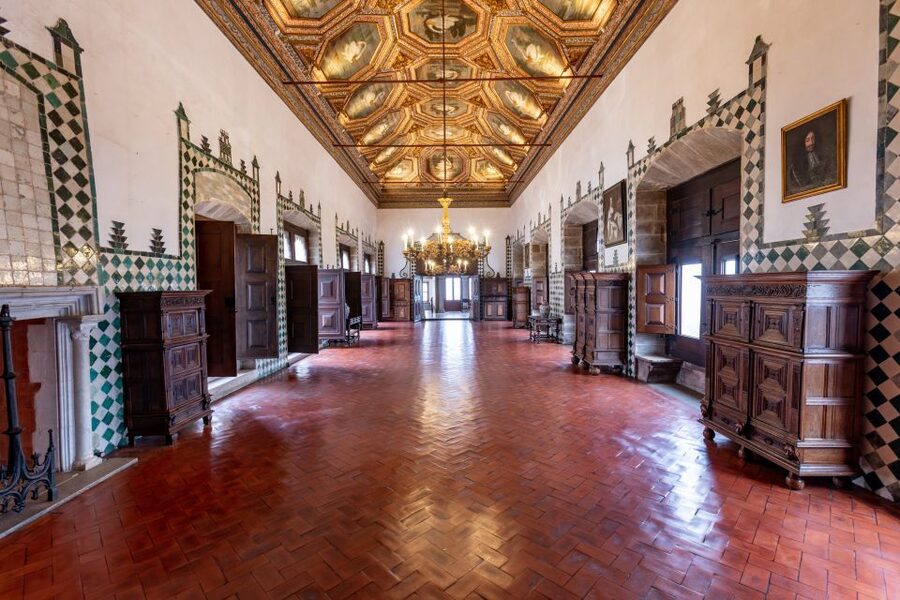
- The interior is the star, especially the patterned tiles, Heraldic Room, chapel, kitchens, and varied royal furnishings.
- Skip-the-line entry helps most at busy times, but it may not save much time on quieter days.
- You’ll climb stairs and walk uneven routes, so this is not an easy visit for anyone with mobility limitations.
- Opening hours are 9:30 AM to 6:00 PM, with last admission at 5:30 PM, so leave enough time before closing.
Why the National Palace deserves a place in your Sintra day
Sintra is packed with famous sights, and it is easy to spend the whole day chasing castles on the hills. The National Palace offers a different experience. It is right in the town center, it does not require a long uphill walk to reach the entrance, and its rooms tell the story of Portuguese royal life through many centuries.
The site began as a Moorish fortress after the Umayyad conquest of Hispania in the eighth century. Portugal’s first king extended the fortress in 1147, and later rulers added new rooms and wings. The result is not one perfectly planned palace. It is a collection of additions built over time, using the shape of the site rather than forcing everything into a neat design.
That makes the building interesting from room to room. One passage may feel medieval, while the next reveals Manueline carving or Mudejar decoration. You can see how Portuguese architecture absorbed Islamic, Gothic, and later influences without losing its own character.
I would not call the National Palace the most dramatic sight in Sintra from the outside. The white walls and twin kitchen chimneys are distinctive, but the building does not have the fairytale outline of Pena Palace. Inside, though, it is often the more satisfying place for anyone who enjoys architecture, royal rooms, and the small details of daily life.
A few more Sintra options side by side
- Sintra: Pena Palace and Park Entrance Ticket
★ 4.2 · 17,410 reviews - Lisbon: Sintra, Pena Palace, Cabo da Roca, & Cascais Tour
★ 4.9 · 3,509 reviews - Quinta da Regaleira Skip-the-Ticket-Line Entry & Audioguide
★ 4.2 · 3,316 reviews
Getting started with a self-guided visit
This ticket is simple in concept. You receive entry to the National Palace for one day, then explore independently. Transportation, food, drinks, and a live guide are not included, so you need to arrange your own way to Sintra and make your own plan for the visit.
The meeting point can vary by the option booked. Read the instructions attached to your confirmation before setting out, especially if you are combining this ticket with another activity. One visitor found the entry arrangement confusing, and another accidentally went to Pena Palace first. The two palaces are different attractions, so check the name carefully before you head uphill.
At the entrance, the skip-the-line ticket can be used directly. This is useful when a queue has formed, though you should keep your expectations sensible. On some afternoons and during quieter months, there may be little or no line. In that case, the ticket is mainly convenient rather than a major time saver.
Once inside, download or prepare the free audio guide app. It is available in Portuguese, English, Spanish, and French. You will get more from the rooms if you listen as you go, since the palace’s unusual layout and changing decoration can be hard to understand from a quick look alone.
The Moorish beginnings and royal additions
The earliest part of the story begins with the Moorish fortress. The National Palace is not simply a medieval royal residence placed on an empty site. Its foundations and form reflect a fortified past, and later kings adapted the building for court life.
The 1147 expansion linked the palace to Portugal’s first king and the early formation of the Portuguese kingdom. After that, successive rulers altered the building. This layered development is one of the reasons the palace feels different from a single-period castle.
As you walk, look for the way courtyards and rooms connect. Later additions made use of the natural shape of the site, creating an irregular plan. You may find yourself turning through narrow routes, crossing open courtyards, and moving up and down staircases rather than following one grand ceremonial axis.
That arrangement is part of the appeal, but it can also make the visit less straightforward. Signage is not always enough to give you a clear sense of where you are. The audio guide helps, and it is worth pausing at the start to get your bearings instead of rushing into the first room.
Manueline details, Mudejar patterns, and glazed tiles
The interior decoration is the palace’s strongest feature. Portuguese tiles are everywhere, but this is not a single display of blue-and-white decoration. You will see geometric patterns, strong color, ornate surfaces, and different design periods layered across the building.
Mudejar influence is especially important. This style reflects the continued use of Islamic artistic forms in Christian Portugal, including geometric decoration and horseshoe-like arches. The palace’s courtyards and interiors show how these forms became part of Portuguese royal architecture.
Manueline work adds another layer. This Portuguese style is associated with the age of overseas exploration and often uses elaborate stone carving, maritime references, and plant forms. Here, it appears alongside older medieval and Mudejar elements, giving the palace a varied look rather than a uniform one.
The windows deserve close attention. Look for openings topped by decorative arches, then compare them with the plain surfaces and patterned tiles around them. The effect is easy to miss if you simply move from room to room with a camera in hand.
Same corner of the country, a different pace:
- Lisbon: Sintra Cascais & Pena Palace Small Group Tour
★ 4.8 · 3,187 reviews - Sintra: Castle of the Moors Skip-the-Line Ticket
★ 4.6 · 2,893 reviews - From Lisbon: Sintra & Cascais Small Group Tour with Tickets
★ 4.8 · 2,224 reviews - Sintra: Quinta da Regaleira Entry Tickets with Host
★ 4.2 · 2,000 reviews
The Heraldic Room and chapel
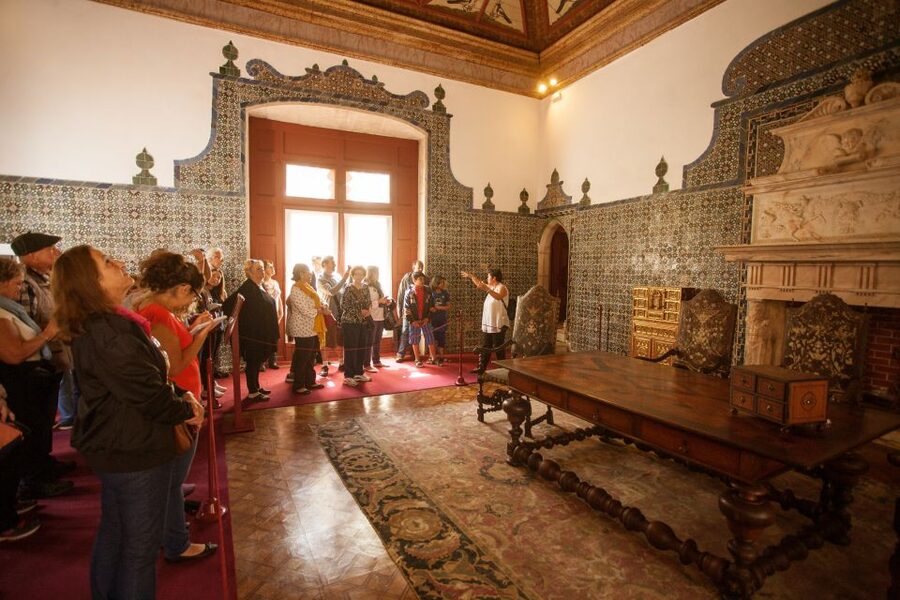
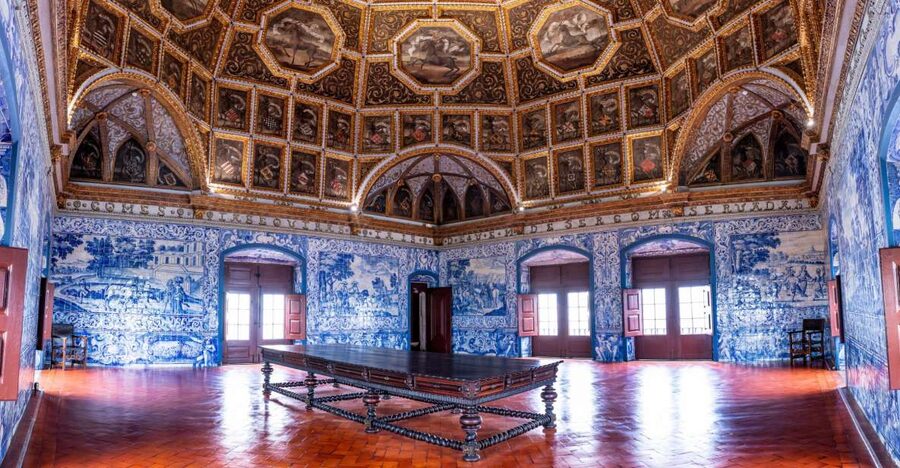
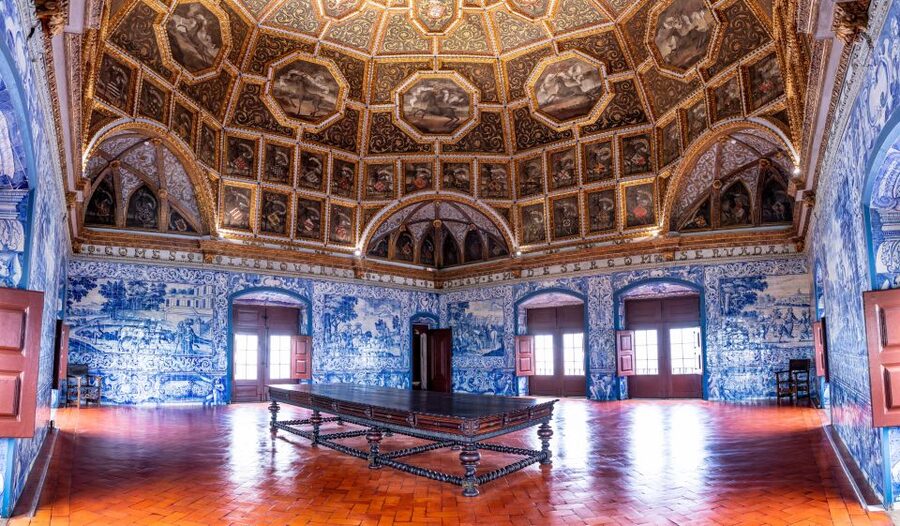
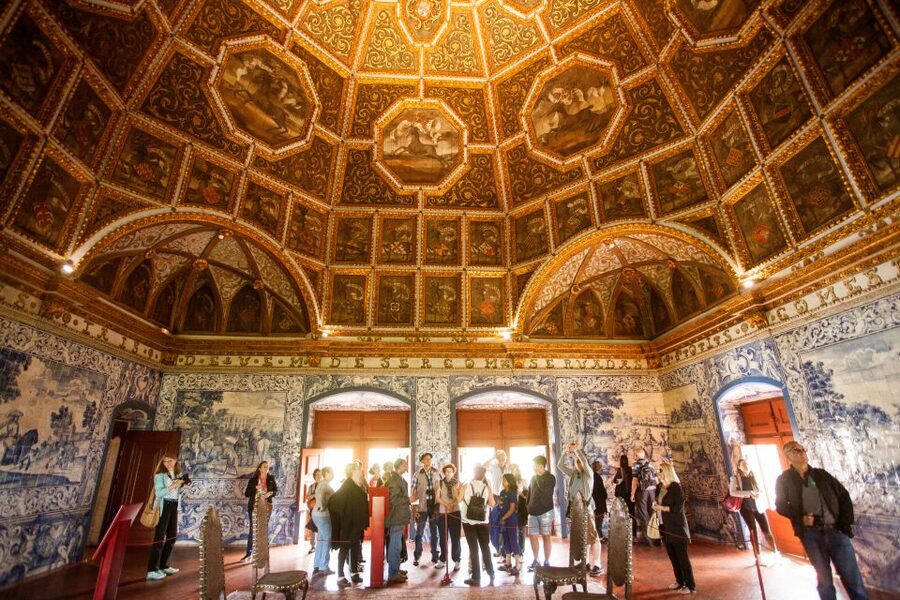
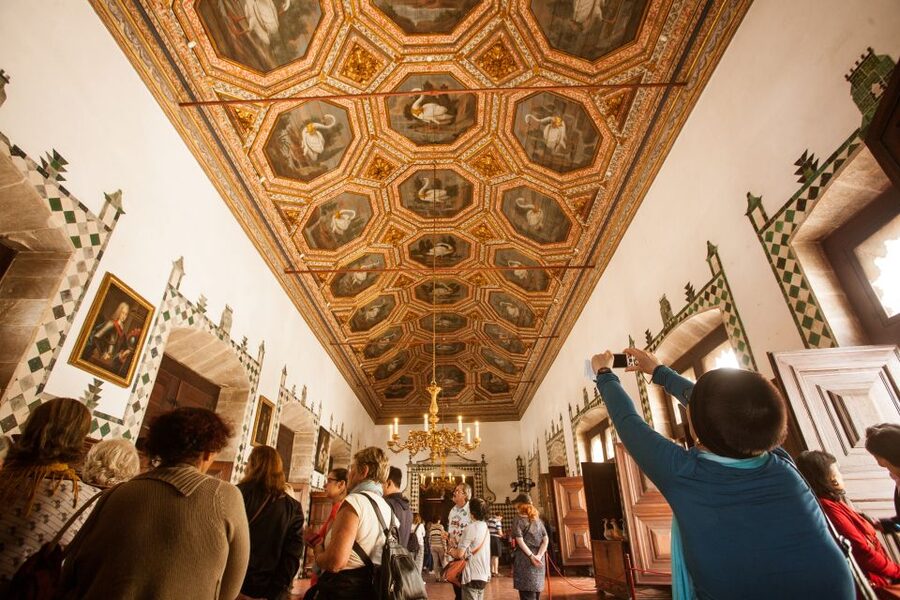
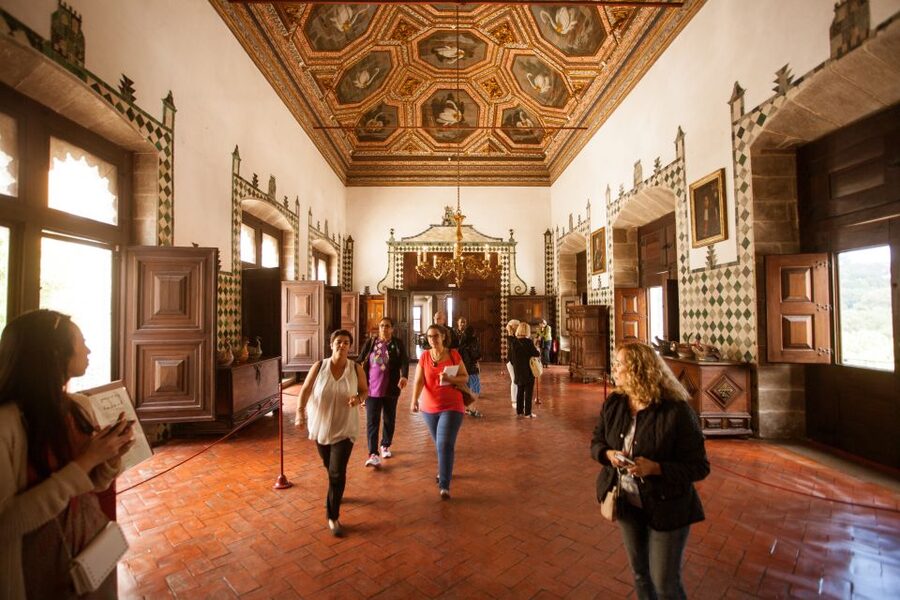
The Heraldic Room is one of the most memorable stops in the palace. Its scale and decoration make it a surprise, especially if you arrive expecting a modest collection of historic rooms. The space presents royal power in a direct way, with heraldic imagery and a formal design that feels very different from the more intimate areas.
Give yourself time here. It is one of those rooms that rewards a slow look upward and around the walls. The room makes clear that this was not only a home. It was also a place where monarchy displayed rank, family connections, and political authority.
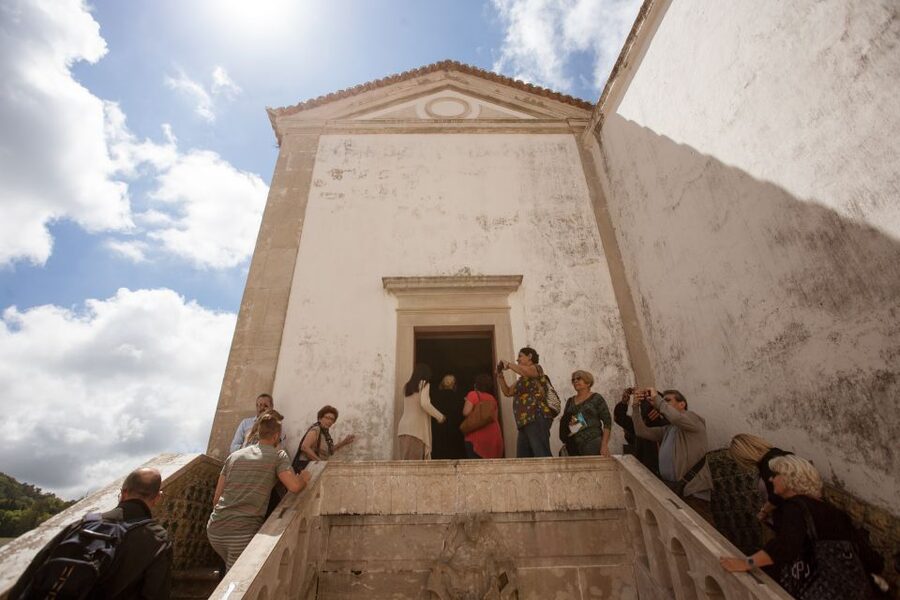
The chapel provides a quieter contrast. It is not as grand as the Heraldic Room, but its decoration and age help show how religious life fitted into the daily routine of the palace. Together, these two rooms give you a useful sense of the public and private sides of royal residence.
Kitchens, courtyards, and the less glamorous royal world
The kitchens are particularly engaging because they bring the palace down to human scale. Royal life depended on large numbers of cooks, servants, and support staff, and the kitchen spaces make that work easier to imagine.
The famous twin chimneys are an exterior symbol of the palace, but the kitchen area explains why they were needed. Look at the size and arrangement of the spaces, then consider the amount of food preparation required for a royal household. This is one of the better places to move beyond portraits and ceremony and think about how the building actually functioned.
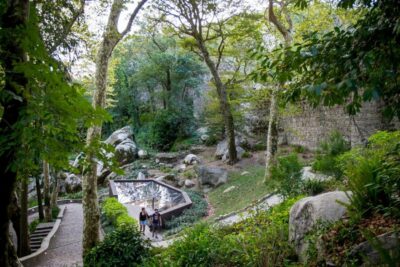
The courtyards add another kind of pleasure. Their water features, arches, tiled surfaces, and changing proportions make them good places to pause between interior rooms. You may find the courtyards more visually appealing than the palace exterior, particularly if you enjoy details instead of grand views.
The gardens are included as part of the setting, but keep your expectations measured. Some people find them pleasant but underwhelming compared with Sintra’s more elaborate garden attractions. They are worth including if you have time, especially after the interiors, but I would not choose this ticket primarily for the gardens.
The new audiovisual portraits of palace life
A new audiovisual experience adds short films to the route. These portraits focus on 14 historical figures, ranging from cooks to queens, and put faces and voices to the people connected with the palace.
This is a useful addition because royal buildings can become impersonal. A room full of tiles and furniture tells you something about wealth and taste, but a story about a cook, court figure, or queen gives the building a more human scale.
The interactive video portraits feature Portuguese actors and are available in Portuguese and English. They complement the existing audio guide, virtual tour, and treasure hunt. You do not need to treat these tools as a separate tour. Instead, use them selectively in rooms that interest you most.
If you have children or teenagers with you, the interactive elements may help hold their attention. If you prefer a quiet, traditional museum visit, you can still focus on the architecture and skip the parts that do not appeal to you.
How much time should you allow?
The palace itself can be seen in about an hour and a bit if you move steadily. I would allow closer to 90 minutes if you plan to listen to the audio guide, examine the tilework, and spend time in the Heraldic Room and chapel.
A short visit to Sintra can work well with this ticket. If you have only three hours in town, the National Palace is more practical than an attraction requiring a long climb or a complicated transfer. You can tour at your own pace and leave when you are ready.
If you are spending a full day in Sintra, do not underestimate the time needed between sights. Pena Palace, Quinta da Regaleira, the Moorish Castle, and the National Palace are separate attractions. A visit to Pena Palace can take longer than expected, and arriving late at the National Palace may leave you without time for the gardens.
I suggest visiting the National Palace earlier rather than treating it as an afterthought. That gives you time to see the interiors before the 5:30 PM last admission and avoids the mistake of reaching the gardens just as they close.
Crowds, stairs, and practical limits

Crowds vary sharply. Summer and peak visit periods can make the palace feel compressed, particularly in narrow rooms and stairways. At quieter times, you may walk through at a comfortable pace with little waiting.
The building involves frequent stairs and some uphill walking around the wider Sintra area. Several visitors found the palace difficult with mobility limitations, citing limited access and a lack of handrails on some steps. If stairs are a serious concern for you, ask about access before booking rather than assuming the skip-the-line ticket changes the physical route.
Fire risk can also affect what you are able to see in Sintra. On one high-risk day, planned outdoor areas were closed. Check current conditions and opening information before you go, since the ticket is non-refundable.
Is the $15 price good value?
At $15 per person, I consider this a solid purchase for an independent palace visit. You are paying for entry to one of Portugal’s most important historic monuments, plus an audio guide in four languages. The price is especially fair if you value the freedom to explore without joining a fixed group.
The ticket is less compelling if you visit during a quiet period and there is no queue. In that case, the skip-the-line feature may not save time, though buying ahead can still make entry easier.
The National Palace is also a good value choice when you are deciding among Sintra’s major sights. Pena Palace is more theatrical, and Quinta da Regaleira is known for its unusual gardens and symbolic features. The National Palace offers a lower-cost way to see an important royal monument, with a visit that can fit into a tighter schedule.
Just remember what you are buying. This is not a guided tour, and there is no transportation. You get the ticket and the app-based audio guide, then you make the visit your own.
Who should book this ticket?
I recommend it most to visitors who enjoy architecture, Portuguese history, tiled interiors, and self-guided sightseeing. It suits couples, independent adults, families who want flexibility, and anyone with limited time in Sintra.
It is also a good choice if you want to avoid the heavier crowds often associated with Pena Palace. The National Palace does not provide the same sweeping hilltop spectacle, but the interior is calmer in character and full of details worth studying.
You may want another attraction instead if gardens are your main reason for visiting Sintra, if you want a live guide, or if stairs and uneven routes would make the visit uncomfortable. The palace is beautiful, but it is not fully easygoing underfoot.
Should you book the National Palace of Sintra?
Yes, if you want an affordable, central, historically important attraction that you can explore at your own speed. The Heraldic Room, chapel, kitchen, courtyards, and tilework make the interior more rewarding than the plain exterior first suggests.
Book it as a focused palace visit, not as a complete Sintra tour. Arrive with enough time before the 5:30 PM last admission, check that you are heading to the National Palace rather than Pena Palace, and use the audio guide. For $15, it is a sensible choice, especially when your day needs a flexible stop with real historical depth and no forced schedule.
FAQ
How much does the National Palace of Sintra ticket cost?
The ticket costs $15 per person.
How long is the ticket valid?
The ticket is valid for one day.
What does the ticket include?
It includes entry to the National Palace of Sintra and a free audio guide through an app.
Is a guided tour included?
No. A live guided tour is not included. The visit is self-guided, with an audio guide available through the app.
Which languages are available for the audio guide?
The audio guide is available in Portuguese, English, Spanish, and French.
Does the ticket include transportation to Sintra?
No. Transportation is not included.
Are food and drinks included?
No. Food and drinks are not included.
What are the palace opening hours?
The National Palace of Sintra is open from 9:30 AM to 6:00 PM.
What is the last admission time?
Last admission is at 5:30 PM. Check the current hours before your visit.
Is the ticket refundable?
No. This activity is non-refundable.
Recently added in Sintra
- Sintra: Private Tour with Guided Pena Palace Experience★ 4.9 · 99 reviews
- Sintra: Walking Tour with Palace, Castle, and Old Town Visit★ 4.9 · 66 reviews
- Sintra: Pena Palace and Park Entry Ticket with Tuk Tuk Ride★ 3.5 · 43 reviews
- Sintra: The Romantic Village – Private Half-Day Guided Tour★ 4.9 · 84 reviews
- Sintra Guided Tour for Small Groups: Pena, Regaleira & Roca★ 4.8 · 48 reviews
- Sintra/Lisbon: Sintra & Quinta da Regaleira Tour with Ticket★ 4.4 · 51 reviews
- Sintra: Self-Drive Trip to All Monuments and Coast★ 4.8 · 48 reviews
- Sintra: Private and Customizable Tour★ 4.3 · 149 reviews
Skip the Line, compared.

Sao Jorge Castle Skip-the-Line Ticket with Guide
Read our review →

Castle of the Moors Skip-the-Line Ticket+Audio Guide
Read our review →
A Local’s Tour of the University + Skip-the-Line
Read our review →
Alfama and the Castle of Saint George Skip the line Tour
Read our review →Browse the lists this tour appears in