
REVIEW · HISTORICAL TOURS
All of Tomar’s history and loads of fun.
Tomar rewards curious walkers. I like the mix of Templar history and local life, from castle walls and the old synagogue to a working pottery studio, and I like that guide Mark adds food tips, legends, and practical advice for the rest of your time in Portugal. The main catch is the climb: this is a real hill walk, with steps, uneven ground, and high castle walls.
This two to three hour tour costs $68.56 per person and is limited to 10 people. Mark is praised for his humor, storytelling, flexibility, and theater background, but you should keep your bearings: the meeting point is in Praça da República, while the tour ends at the Convent of Christ. Admission to the convent is not included.
In This Review
- Key points to know before booking
- Why this Tomar walk is more than a castle visit
- Starting at Praça da República
- The 500-year-old Synagogue of Tomar
- Climbing to Castelo de Tomar
- The Convent of Christ and the choice to enter alone
- Mouchão Park and the Nabão River
- Matchboxes, art, and the less expected Tomar
- A pottery workshop with a practical souvenir
- What the $68.56 price gets you
- Who will enjoy this walk most
- Timing, fitness, and cancellation details
- Should you book the Tomar walking tour?
- FAQ
- Where does the Tomar walking tour begin?
- Where does the tour end?
- How long does the experience last?
- Is admission to the Convent of Christ included?
- How difficult is the walking route?
- How many people can join the tour?
- What is the cancellation policy?
Key points to know before booking
- Walk the 100-foot castle walls: The climb leads to broad views over Tomar, but it requires moderate fitness and a steady pace.
- Hear Tomar’s Templar story: The castle and Convent of Christ give the town its defining medieval chapter.
- Visit Portugal’s oldest synagogue: A brief stop opens a difficult but important window onto Jewish life in medieval Europe.
- See working Portuguese ceramics: A small studio lets you watch artists make, paint, and design pottery.
- Get useful local advice: Mark shares places to eat and drink, market tips, Portuguese customs, language help, and ideas for nearby sights.
- Plan for the convent separately: You finish at the Convent of Christ, but the entry fee is extra and the guide does not lead you inside.
Why this Tomar walk is more than a castle visit
Tomar can look like a simple day trip built around one famous monument. That would miss the point. The town’s story runs from the Knights Templar to Jewish heritage, river engineering, local food, craftwork, and the everyday streets around Praça da República.
This tour connects those pieces on foot. You move from a small historic synagogue to a hilltop fortress, then down through gardens and along the Nabão River. The route also includes the Mouchão water wheel, a matchbox museum pointer, an art gallery in a former food store, and a pottery workshop.
I like that range. You are not spending the whole time listening to dates beside a single monument. You get a sense of how Tomar works as a town.
Mark is the central reason the experience earns such strong praise. He is described as funny, warm, well informed, and an excellent storyteller. His theater background appears to shape the way he presents the past, using local legends and human stories rather than giving you a dry list of rulers and building styles.
That personal approach also seems useful for solo visitors. One person specifically found the tour comfortable as a solo woman, and several people appreciated Mark’s willingness to adjust the pace and answer questions. If you want a fixed script with no variation, this may feel less formal. If you prefer to ask questions and follow your interests, that flexibility is a plus.
More History Tours in Coimbra:
- Lisbon: History, Stories and Lifestyle Walking Tour
★ 4.8 · 10,902 reviews - Douro Valley: Historical Sites, Wine Experience, Lunch & Cruise
★ 5.0 · 5,133 reviews - Lisbon: Live Fado Show with Port Wine in Historic Center
★ 4.7 · 4,166 reviews
Starting at Praça da República
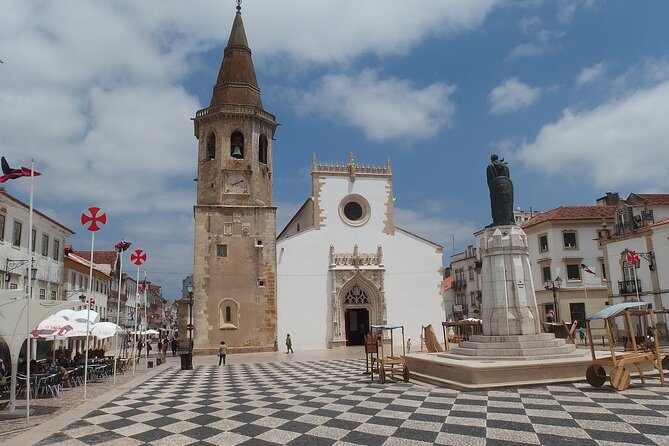
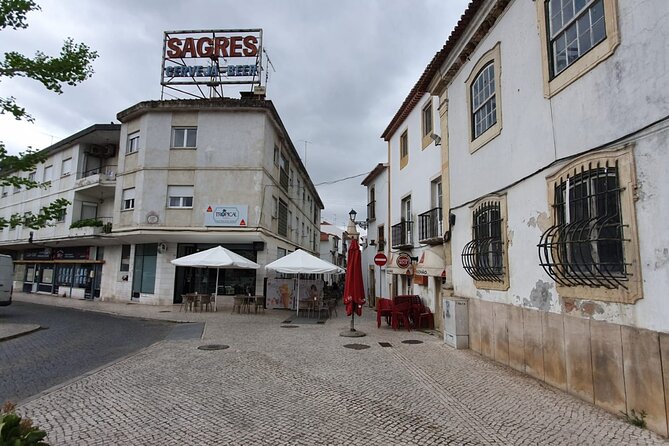
The tour begins at Praça da República, the main square in central Tomar. It is a sensible place to meet because you can find bars, restaurants, churches, and the statue of Gualdim Pais, the man linked with the building of Tomar’s castle.
This is also a useful orientation point. You begin among the town’s daily life before moving into its military and religious past. If you arrive early, the square gives you a chance to get settled before the walking starts.
Take the meeting point seriously. The official start is Praça da República, not the church or castle at the top of the hill. One booking went wrong after map directions led the party uphill, and the group had already left. The guide’s stated waiting time was limited, so read the confirmation details carefully and contact the guide if you are unsure.
That is a small practical issue, but it matters. Tomar’s monuments sit above the town, and map apps can make the wrong destination look plausible.
The 500-year-old Synagogue of Tomar
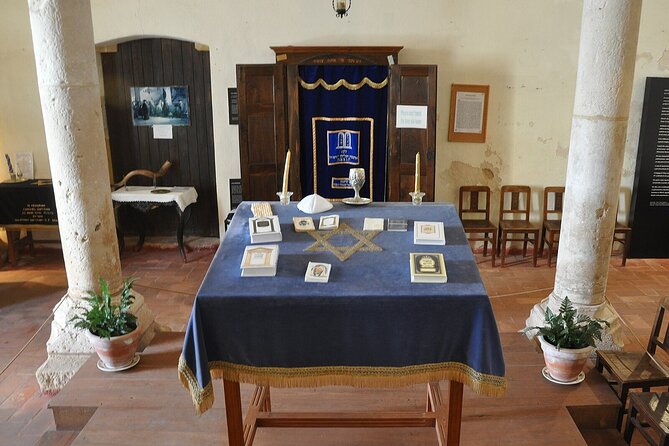
The Synagogue of Tomar is a short stop, around 10 minutes, and admission is free. It is presented as Portugal’s oldest synagogue, about 500 years old, with a history shaped by the pressure and persecution faced by Jewish communities in medieval Europe.
Do not judge this stop by its length. Ten minutes is enough to introduce a place that many people would otherwise walk past. The value comes from the context Mark provides, especially the human cost behind the building’s age.
The synagogue adds needed balance to the Templar story. Tomar is often presented through knights, fortifications, and Christian power. This stop reminds you that other communities lived through the same centuries under very different conditions.
Because the visit is brief, you should not expect a long museum session. Think of it as a focused introduction, then use the rest of your time in Tomar to return if you want a slower look.
Climbing to Castelo de Tomar
The castle is the physical high point of the route. Built in the 12th century by the Knights Templar, it served as their headquarters and occupied a commanding position above Tomar.
You will see thick walls, towers, and a keep. The structure combines military purpose with religious meaning, and later additions bring in other architectural periods. The castle and Convent of Christ together are recognized by UNESCO, making this the essential historical stop in town.
The guide’s route is one of the tour’s most distinctive features. Mark takes you along less obvious Templar paths, through the Seven Hills Natural Forest, and toward the so-called fountain of blood. The route is intended to avoid the heaviest flow of people and show you parts of the site that are easy to miss when you simply follow the main approach.
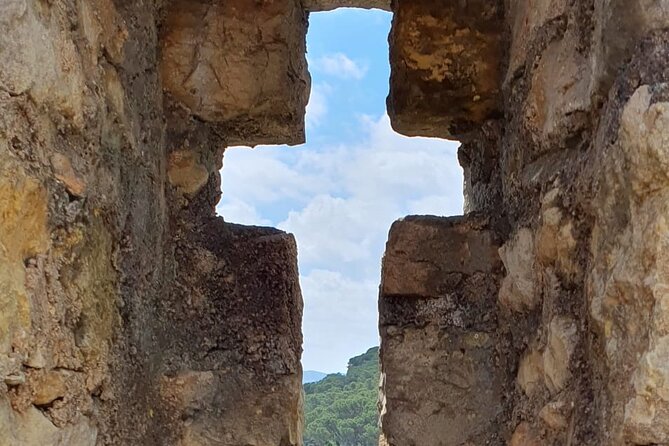
The best reward comes on the walls. You climb to a height of about 100 feet, with views across the town and surrounding countryside. Several people singled out the wall walk and the views as memorable.
The warning is equally clear: there are many steps. One person described the route as difficult for anyone not prepared for a climb, while older visitors said they managed it at a careful pace. You should have moderate physical fitness, wear sensible shoes, and allow yourself time rather than trying to rush.
The castle is not a flat museum. If you have knee problems, balance concerns, or difficulty with steps, ask about the route before booking. The tour may be adaptable, but the hill and walls are central to the experience.
A few more Coimbra options side by side
- Coimbra: Live Fado Show with Glass of Port Wine
★ 4.7 · 998 reviews - University of Coimbra guided tours without queue
★ 5.0 · 518 reviews - Guided tour of the University and city of Coimbra.
★ 5.0 · 377 reviews - Coimbra: Mondego River Kayaking Tour
★ 4.7 · 324 reviews
The Convent of Christ and the choice to enter alone
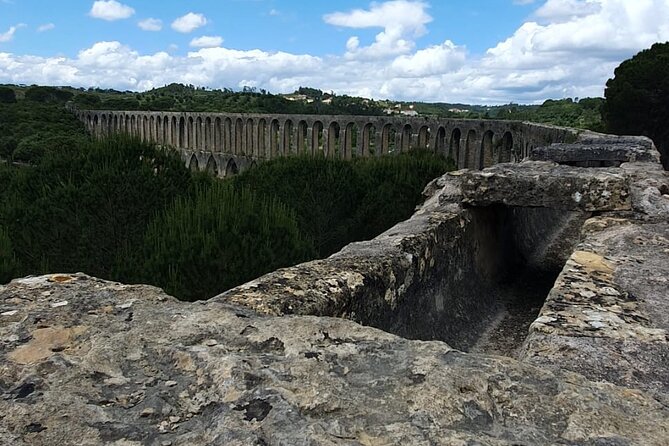
The tour ends at the Convent of Christ, but the guide does not take you inside. Admission is not included, and the stated reason is practical: you do not need to pay a guide to repeat obvious information while you look at the building.
That approach will suit some people and disappoint others. You save the cost of a guided entry and gain time to explore the complex at your own pace. You also need to handle the admission and interpretation yourself.
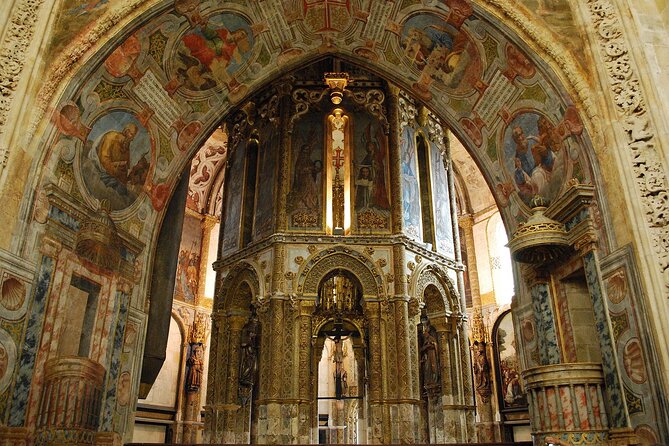
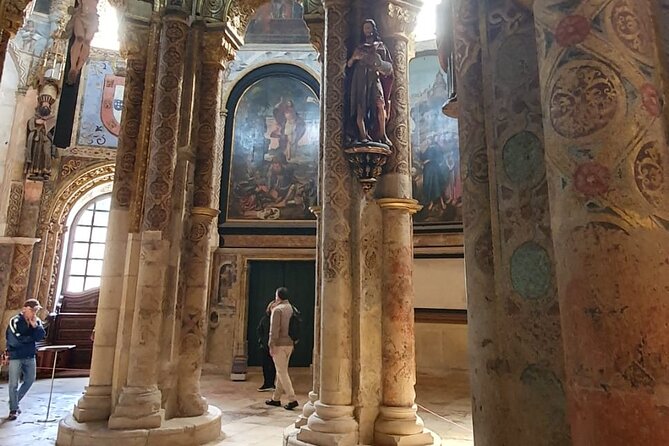
The convent began as a Templar stronghold in the 12th century. Over time, it grew into a large complex with Romanesque, Gothic, and Renaissance elements. Its Charola, a round church with Templar symbols, is the architectural centerpiece.
The building also connects Tomar to Portugal’s Age of Discovery. That broader story matters because the convent is not just a medieval fortress. It shows how a military religious order’s base changed as Portugal’s politics, wealth, and ambitions changed.
Plan your timing carefully. One couple arrived late and lost the chance to see the convent properly. If you are driving from Lisbon, leave enough time for the journey and for finding the meeting point. Since the tour finishes here, you can visit the convent afterward if opening hours and your schedule allow.
Mouchão Park and the Nabão River
After the hilltop monuments, the route shifts into a gentler part of Tomar. The Roda Hidráulica do Mouchão is a historic water wheel in Mouchão Park, beside the Nabão River.
The wheel dates from the 17th century and once formed part of the town’s irrigation system. Built with wood and iron, it used the river’s power to help supply water to nearby areas. Today it is a pleasant photographic stop, but the guide gives it a practical purpose in the town’s story.
I enjoy this kind of detail because it shows how old towns functioned. Fortresses and churches get the attention, yet water systems often mattered just as much to daily life.
The walk beside the river adds another change of pace. You follow the meandering Nabão through the center of town while Mark shares local stories and secrets. The river is not merely scenery here. It helps explain why this place developed where it did and gives the walk a calmer stretch after the castle climb.
Matchboxes, art, and the less expected Tomar
The route includes several unusual points that help separate this from a standard monument walk. Mark points out the world’s largest collection of matchboxes. The stop is brief, but it offers the sort of odd local detail you are unlikely to find in a basic guidebook.
You also see an art gallery housed in a former food storage building. That setting gives the gallery a local sense of place rather than making it feel like an isolated cultural stop.
These small discoveries are important to the tour’s character. They keep the experience from becoming a straight line between the synagogue, castle, and convent. You get the famous sights, but also reminders that Tomar is a living town with curious corners and reused old buildings.
The included local advice adds further value. Mark shares recommendations for places to eat and drink, along with information about the market and the surrounding area. The market visit is available except on Monday and Sunday, so the day of your tour matters.
If you are staying in Tomar for more than a day, this help becomes especially useful. One person staying in the area for four weeks received suggestions for additional activities around town and beyond. You can also expect some Portuguese language and etiquette tips, which are small additions but helpful when ordering food or dealing with local shops.
A pottery workshop with a practical souvenir
The pottery and tile workshop is one of the most personal stops. It is run by two women, and you can watch the team make, paint, and design ceramics in front of you.
This is a working studio, not just a display room. That distinction matters. You see the hands-on process and get a chance to buy something made there if you have space in your luggage.
The stop lasts about 10 minutes, so it is an introduction rather than a full craft class. Still, it brings Portuguese design into the tour in a direct way. After hearing about medieval walls and religious buildings, you see a current local trade continuing in real time.
If you like useful souvenirs, this is more appealing than another generic shop. Just remember that fragile pottery can be awkward to carry, especially if Tomar is only one stop on a longer trip.
What the $68.56 price gets you
At $68.56 per person, this is not the cheapest way to walk around Tomar. The castle and synagogue stops are listed without separate admission charges, and you still pay for the Convent of Christ. If you only want to see the main monuments and read the signs yourself, the price may feel high.
The value comes from the range and the guide. In a two to three hour period, you receive historical interpretation, local legends, a route through castle walls and forest paths, food and drink suggestions, market information, a pottery workshop, and ideas for onward travel.
A small group of no more than 10 also changes the feel. You have a better chance to hear the guide, ask questions, and move at a reasonable pace than you would in a large coach group. Mark’s willingness to adjust the walk to people’s interests is another part of what you are paying for.
I would consider the price fair if Tomar is important to your Portugal plans and you want the town explained by someone who lives there. I would be less enthusiastic if you are on a tight budget, dislike hills, or mainly want independent time inside the convent.
The tour is offered in English and uses a mobile ticket. It is usually booked about 19 days ahead, which suggests you should not leave it until the last minute if your Tomar date is fixed.
Who will enjoy this walk most
I would recommend it most to:
- First-time visitors who want Tomar’s major stories explained clearly.
- People fascinated by the Knights Templar and medieval fortifications.
- Visitors who enjoy local legends alongside established history.
- Solo visitors who want a social but small-group experience.
- People staying in Tomar for several days and looking for restaurant and day-trip ideas.
- Anyone who prefers a working craft studio and river walk to a monument-only tour.
It is less suited to anyone who wants a flat route or cannot manage repeated steps. The castle climb is not a minor detail. It shapes the whole experience.
It is also not ideal if you need a guided tour inside the Convent of Christ. You will finish at the entrance, then explore the UNESCO site independently after paying admission.
Timing, fitness, and cancellation details
Allow two to three hours for the full walk, with the exact pace shaped by the group. The stated fitness requirement is moderate, and that is a fair description. You climb to the castle, walk along high walls, and cover paths through the forest and town.
The start is at Praça da República and the end is at the Convent of Christ, Igreja do Castelo Templário, on Estrada do Convento. The route is near public transportation, but you should confirm the exact meeting details before setting out.
Free cancellation is available up to 24 hours before the local start time. Inside that window, the payment is not refunded, and changes are not accepted.
Should you book the Tomar walking tour?
Book it if you want Tomar to make sense, not just look pretty. Mark’s strongest qualities are his storytelling, humor, local knowledge, and ability to shape the walk around the people in front of him.
The best reason to go is the combination of castle walls, Templar history, Jewish heritage, river life, craft, and useful food advice. The main reasons to hesitate are the steep climb, the extra cost of the Convent of Christ, and the need to arrive at the correct meeting point.
For most active visitors with an interest in history, this is a strong use of a morning or afternoon in Tomar. Bring good shoes, arrive at Praça da República with time to spare, and save enough energy and money to explore the convent after the tour.
FAQ
Where does the Tomar walking tour begin?
It begins at Praça da República, 2300 Tomar, Portugal.
Where does the tour end?
The tour ends at the Convent of Christ, Igreja do Castelo Templário, Estrada do Convento, 2300-000 Tomar, Portugal.
How long does the experience last?
The tour lasts approximately two to three hours.
Is admission to the Convent of Christ included?
No. Admission to the Convent of Christ is not included, and you visit the interior independently.
How difficult is the walking route?
You should have a moderate level of physical fitness. The route includes a climb to the castle, many steps, and walking along walls about 100 feet high.
How many people can join the tour?
The group has a maximum of 10 people.
What is the cancellation policy?
You can cancel at least 24 hours before the local start time for a full refund. Cancellations or changes made within 24 hours are not accepted and are not refunded.
Recently added in Coimbra
- Lousa Mountain Private Tour★ 5.0 · 88 reviews
- Time travel at the Convent of Christ Tomar★ 5.0 · 56 reviews
- Soft Canyoning, river Ceira, Góis, Serra da Lousa, Coimbra★ 5.0 · 48 reviews
- Schist Villages at Lousa Mountain★ 5.0 · 127 reviews
- Discovering the charms and places of Coimbra★ 5.0 · 78 reviews
- University of Coimbra – more complete and private visit, ticket included★ 5.0 · 53 reviews
- Schist Villages of Lousã Mountain, half-day from Coimbra★ 5.0 · 42 reviews
- Discovering Nature in Serra da Lousã★ 5.0 · 38 reviews
Historical Tours, compared.


Douro Valley: Historical Sites, Wine Experience, Lunch & Cruise
Read our review →
Live Fado Show with Port Wine in Historic Center
Read our review →

Browse the lists this tour appears in