
REVIEW · WALKING TOURS
Lisbon: Belem Walking Tour with Jeronimos Monastery Entry
History is best when you can walk through it. This Belem tour gives you prepaid entry to Jeronimos Monastery, a major time saver at one of Lisbon’s busiest sights, then links the monastery to the discoveries memorial, Belem Tower, and the famous Pastel de Belem bakery. I also like the way the guides connect the carvings, royal tombs, ships, and religious life to Portugal’s 15th- and 16th-century voyages. The main drawback is important: Belem Tower is closed for restoration, so you can see and hear about it from outside but cannot go in.
The three to three-and-a-half-hour route costs $70 per person. That is not a bargain-priced stroll, but the ticket, guide, and custard tart make the fee easier to justify. You should also expect a fair amount of walking, sun, and some uneven historic spaces, so this is not a good match for wheelchair users or people with major mobility limits.
In This Review
- The important points at a glance
- Why Jeronimos Monastery is worth the early start
- Santa Maria de Belém Church and Portugal’s famous tombs
- Pastéis de Belém and the original custard tart
- Empire Square Garden and the walk toward the river
- Monument to the Discoveries: powerful symbol, complicated subject
- Belem Tower from the outside during restoration
- How the guides shape the experience
- Is $70 a fair price?
- Who should book this Belem tour?
- FAQ
- How long does the Belem walking tour last?
- Where does the tour begin?
- Is entry to Jerónimos Monastery included?
- Does the tour skip the regular monastery line?
- Is the Pastel de Belém included?
- Can I enter Belem Tower?
- Is lunch included?
- Is the tour suitable for wheelchair users?
- Should you book it?
The important points at a glance
- Jerónimos entry is the tour’s strongest practical benefit: Your ticket is already purchased, and you use a separate access line rather than joining the regular ticket queue.
- The monastery visit lasts about 90 minutes: You see the upper and lower cloisters, the Chapter Room, old Refectory, church, and notable tombs.
- The guide adds the meaning most signs leave out: Guides such as Luis, Leonardo, Federico, Leo, and Daniel are praised for clear English, historical context, humor, and thoughtful answers.
- Pastel de Belém is part of the experience: You stop at the original bakery and try the custard tart linked to the monastery’s monks.
- The route ends at Belem Tower: You receive an exterior visit and explanation, but restoration work currently prevents entry.
- It works best as a morning introduction to Belem: The route is focused, active, and history-heavy, with no lunch or transportation included.
Why Jeronimos Monastery is worth the early start
The tour begins at Mosteiro dos Jerónimos, where the guide waits near the entrance queues and close to the church’s south entrance. The planned entry is around 9:30 in the morning. Arrive early. One person was nearly late after traffic delayed a ride, and a late arrival can hold up a small group.
The guide already has the monastery tickets. That matters because the regular line can be long, especially on a busy day. Several people specifically praised the quick, orderly access, and one person who had considered visiting alone was glad to have someone explain the building rather than simply look at it.
Your visit starts in the upper cloister. This is the visual high point of the tour, with ornate stonework, slender columns, carved arches, and open views into the central courtyard. The style is Manueline, Portugal’s early 16th-century blend of late Gothic structure and Renaissance ideas. It is a style full of maritime references and fine stone detail, but the guide helps you see that it was also a statement of power.
The monastery was tied to Portugal’s royal ambitions and its ocean voyages. The building’s scale and decoration make more sense when you understand the money, faith, monarchy, and trade behind it. A good guide turns the cloister from a pretty photo stop into a place with a political and religious purpose.
You then move into the lower cloister. The Chapter Room and old Refectory show a quieter side of monastic life. The tomb of Fernando Pessoa is another striking detail. Pessoa, one of Portugal’s best-known modern writers, was moved to the monastery in the 20th century, long after the building’s original religious role had changed.
This is where a guide earns the fee. The building contains plenty to look at but relatively little information for a first-time visitor. Without help, you can admire the carvings and leave without understanding who commissioned them, what the symbols meant, or how the monastery related to Lisbon’s seafaring age.
More Walking Tours in Lisbon
- Lisbon: History, Stories and Lifestyle Walking Tour
★ 4.8 · 10,902 reviews - Best of Lisbon Small-Group Guided Walking Tour
★ 5.0 · 4,869 reviews - Lisbon: Food and Wine Small Group Walking Tour
★ 4.9 · 4,082 reviews
Santa Maria de Belém Church and Portugal’s famous tombs
The monastery visit includes Santa Maria de Belém Church, a majestic space that continues the Manueline design. Here, the tour shifts from the cloister’s detailed stonework to the building’s royal and national memorial role.
King Manuel I and his son, João III, are buried here, linking the church to the Avis dynasty. The church also contains the tomb of Vasco da Gama, the navigator whose voyage to India became one of Portugal’s defining achievements. Luiz Vaz de Camões, the country’s great poet and author of The Lusiads, is also buried here.
These names can sound like a list from a history textbook. The guide’s job is to explain how they fit together. Royal authority, Catholic faith, overseas expansion, literature, and national identity all meet in this one church.
Guides Luis and Leonardo receive especially strong praise for presenting the material in an easy, lively way. Federico is also praised for explaining Portuguese history from a modern point of view, helping visitors think about both the scale of the achievements and their wider meaning.
The pace appears carefully judged for most people. One person found the amount of information almost too much to follow, so do not expect a light introduction with only a few dates. If you enjoy history, art, and architecture, you will probably appreciate the detail. If you prefer a quick look and plenty of free time, the monastery section may feel full.
Pastéis de Belém and the original custard tart
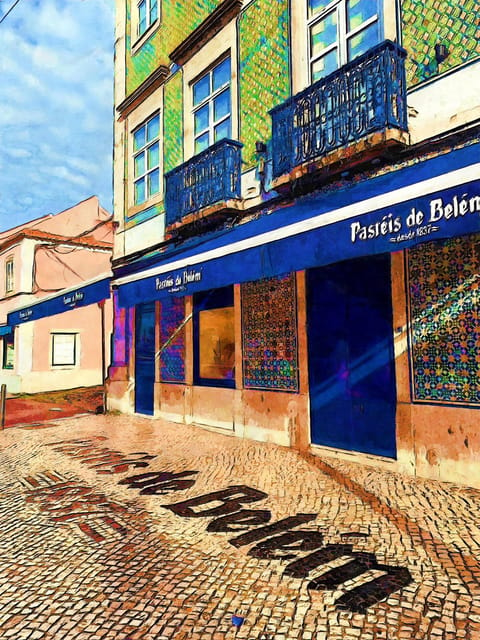
After the monastery, you stop at Pastéis de Belém to try the original custard tart. The recipe is linked to the monks of Jerónimos Monastery and has been sold at the same establishment since the mid-19th century.
The pastry is not just a snack added to fill time. It gives the tour a direct connection between the monastery and everyday Lisbon. You have just heard about the religious community that created the recipe, then you taste the result at the bakery associated with it.
The included tart is a small but welcome part of the $70 price. Several people singled it out as one of the best Portuguese tarts they had during their time in Portugal. It also breaks up the history before the next stretch of outdoor walking.
The stop is listed as about 30 minutes. Lunch is not included, so do not treat this as a meal. You may want to plan a separate lunch after the tour, especially because the final stop is at Belem Tower rather than back at the starting point.
Empire Square Garden and the walk toward the river
The route continues through Empire Square Garden, with about 15 minutes of walking. This section gives you a change of pace after the monastery and church. You are no longer studying a carved column or royal tomb. Instead, you are moving through the broad public setting that connects Belem’s monuments.
The area’s open spaces are part of its appeal, but they also expose you to Lisbon’s weather. On a hot day, the walk can feel harder than the distance suggests. One person completed the tour on a very warm morning and still enjoyed it, while another joined during heavy rain and found the experience worthwhile. The tour runs in rain or sunshine, so bring sunscreen and an umbrella.
Wear comfortable shoes, light comfortable clothing, a sun hat, and sunscreen. The operator specifically advises all of these. You do not need special equipment, but you do need to be ready for a long outdoor morning with stops on hard surfaces.
Same corner of the country, a different pace:
- Lisbon City Center Tour – The Unmissable Lisbon
★ 5.0 · 22,234 reviews - Lisbon: Sintra, Pena, Regaleira, Cabo da Roca & Cascais
★ 4.7 · 19,656 reviews - Lisbon: Jerónimos Monastery Entrance Ticket
★ 4.1 · 14,164 reviews - Lisbon: Sunset Boat Party Cruise with DJ and Open Bar
★ 4.5 · 10,378 reviews
Monument to the Discoveries: powerful symbol, complicated subject
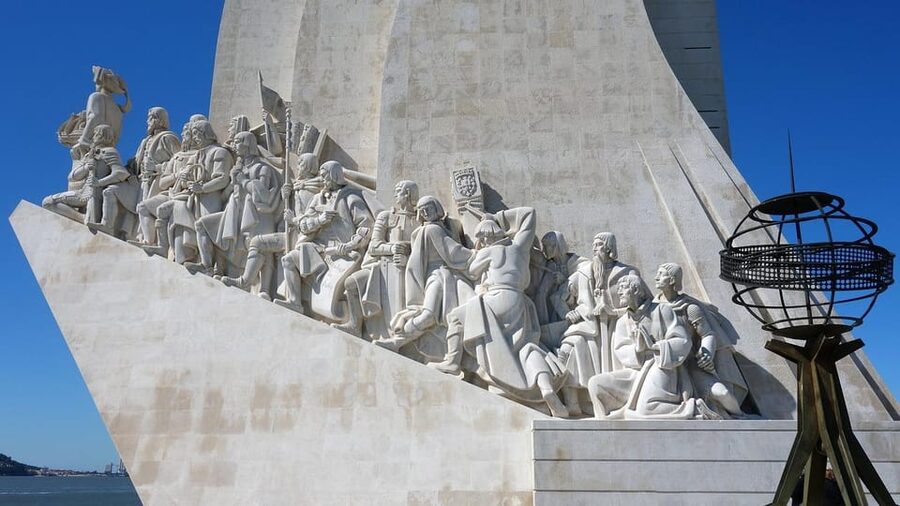
The Monument to the Discoveries was erected in 1960 to mark the 500th anniversary of the death of Infante D. Henrique, known as Henry the Navigator. He appears with other figures connected to Portugal’s great voyages and the spread of Portuguese culture around the world.
The monument is a bold piece of 20th-century national storytelling. Your guide explains who the figures are and why they were included, giving you a clearer way to read the sculpted procession rather than treating it as a giant riverside photo backdrop.
This is also a useful place to keep the Age of Discovery in perspective. The tour focuses on Portugal’s achievements and influence, but the subject can raise wider questions about empire, power, and the effects of overseas expansion. The supplied details do not promise a full critical history of colonialism, so you should see this stop as an introduction to the monument and the navigation era, not a complete treatment of every consequence.
The guided visit lasts about 20 minutes. That is enough time to understand the monument’s purpose and main figures, but not enough for a long museum-style discussion.
Belem Tower from the outside during restoration
A walk of roughly 15 minutes brings you to Belem Tower, one of Lisbon’s best-known landmarks. Together with Jerónimos Monastery, it has UNESCO World Heritage status.
The tower is another example of Manueline architecture. It was built as a defensive point to protect access to Lisbon from invaders approaching by water. Its position beside the Tagus makes that defensive role easier to imagine, even if the elegant carved details can make it look more like a palace than a military structure.
At present, restoration work means you cannot enter Belem Tower. The guide takes you to the exterior and explains its function, design, and place in Belem’s story. That is useful, but it is also the tour’s clearest limitation. If going inside the tower is one of your main reasons for visiting Belem, you should wait until restoration work ends or confirm the current status before booking.
Several people still felt the exterior explanation made the stop worthwhile. One guide used the closed tower as a chance to provide plenty of context, and another took visitors around the outside so they did not feel the landmark had simply been skipped. Even so, the product should be understood as an outside visit for now.
The tour ends here. Since transportation is not included, you are responsible for arranging your next move. The route does not return you to Jerónimos Monastery.
How the guides shape the experience
The most praised part of this tour is the guiding. Luis is repeatedly described as warm, clear, prompt with communication, and able to answer questions without making the visit feel like a school lesson. Leonardo and Leo receive similar praise for enthusiasm, humor, and a strong grasp of Portuguese history.
Federico is singled out for engaging explanations and for connecting the monastery’s architecture to the monarchy and the navigation era. Other named guides include Renan Stein, Daniel, Ricardo, and Frederick. The guide you receive depends on the date and assignment, so you should not book expecting one particular person unless the operator confirms it.
A useful detail is that guides may use pictures to explain historical context. That can help when the building itself gives you no easy visual clue about an earlier period. Headsets were also provided for at least one group, which can make explanations easier to follow in a crowded monument, though this should not be treated as guaranteed unless confirmed at booking.
The language is English. Private groups are available, which may suit families or couples who want more control over questions and pace. The standard group size is not specified, although several accounts describe small groups, including one with only four people. A small group can make a major difference in a place where you want to ask about details rather than simply listen from the back.
Is $70 a fair price?
At $70 per person, this is a midrange guided sightseeing experience. You are paying for the Jerónimos Monastery entrance ticket, a live English-speaking guide, skip-the-line access through a separate entrance, and an original Pastel de Belém.
The strongest value comes from combining time savings with interpretation. You could visit some of the outdoor monuments independently, but the monastery queue and the lack of detailed signs inside make a guided visit more useful. The ticket alone does not explain the Chapter Room, Refectory, royal tombs, Manueline carvings, or the link to the voyages.
The value is weaker if you mainly want independent time, a full meal, or entry to Belem Tower. Lunch and transportation are extra, and tower access is currently unavailable. Still, for a first visit to Belem, the tour covers the essential sights in one organized morning and avoids the most annoying queue.
Free cancellation is available up to 24 hours before the tour, and you can reserve now while paying later. The tour can be canceled if the minimum number of participants is not reached, so check the final booking terms and messages before setting your day around it.
Who should book this Belem tour?
I would recommend it to you if this is your first time in Belem and you want the major sights explained in a sensible order. It suits people who care about architecture, monarchy, religion, literature, and Portugal’s seafaring past.
It is also a good choice if you dislike waiting in ticket lines. The early start and prepaid monastery admission are practical advantages, especially during busy periods.
You may prefer to visit independently if you want to linger for hours, avoid a fixed pace, or spend most of your time inside Belem Tower. You should also choose another plan if walking is difficult, since the experience is not suitable for wheelchair users or people with mobility impairments.
Do not arrive late. The meeting point is in front of the monastery entrance, near the south entrance to the church, and the operator advises you to use the provided meeting-point photo to avoid confusion. Lisbon traffic can be slow, so leave extra time if you are coming by ride service.
FAQ
How long does the Belem walking tour last?
The tour lasts about three to three-and-a-half hours, depending on the starting time and pace of the group.
Where does the tour begin?
It begins at Mosteiro dos Jerónimos. The guide waits near the entrance queues, close to the south entrance of the Jerónimos Monastery church.
Is entry to Jerónimos Monastery included?
Yes. Your entrance ticket is included, and the guide has the tickets purchased before the group enters.
Does the tour skip the regular monastery line?
Yes. The activity uses a separate entrance to help you avoid the main ticket queue.
Is the Pastel de Belém included?
Yes. An original custard tart from Pastéis de Belém is included in the tour.
Can I enter Belem Tower?
No. Belem Tower is currently undergoing restoration work and cannot be visited inside. The tour includes an exterior visit and an explanation of the tower.
Is lunch included?
No. Lunch and transportation are not included, so plan your meal and onward transport after the tour ends at Belem Tower.
Is the tour suitable for wheelchair users?
No. The tour is not suitable for wheelchair users or people with mobility impairments.
Should you book it?
Book this tour if you want fast monastery access and a guide who brings the stonework to life. The strongest part is the 90-minute visit inside Jerónimos Monastery, where the historical explanation adds far more than a quick self-guided look.
The custard tart is a pleasant local touch, and the Monument to the Discoveries and Belem Tower give you a useful sense of the wider district. Just adjust your expectations about the tower closure, bring weather protection, and allow extra time to reach the meeting point. For a first, focused morning in Belem, $70 is a fair price for the time saved and the context gained.
Recently added in Lisbon
- Lisbon Cinematic Photoshoot with Top-Rated Photographer★ 5.0 · 76 reviews
- City Centre Run in Lisbon★ 5.0 · 164 reviews
- City of Neighborhoods Tour 1H 30M Private Tour by Tuk Tuk★ 5.0 · 38 reviews
- Central Lisbon E-Bike Tour★ 5.0 · 168 reviews
- Hands on Portuguese Cooking Class in Lisbon★ 5.0 · 136 reviews
- Lisbon Sailing Catamaran Public Cruise with drinks★ 5.0 · 304 reviews
- Lisbon City Tour by Tuk Tuk★ 4.5 · 137 reviews
- Romantic Private Sailboat in Lisbon for couples★ 5.0 · 38 reviews
Walking Tours, compared.


Best of Lisbon Small-Group Guided Walking Tour
Read our review →
Porto Walking Tour, Lello Bookshop, River Cruise and Cable Car
Read our review →

Best of Lisbon Walking Tour: Rossio, Chiado & Alfama
Read our review →
Experience Porto’s Charm: 3-Hour Guided Walking Tour
Read our review →
Enjoy a Guided Levada Walk in the Rabaçal Valley
Read our review →Browse the lists this tour appears in