
REVIEW · WALKING TOURS
Belém District and the Salazar Dictatorship Legacy – Private Walking Tour
Belém hides Portugal’s uncomfortable modern past. This three-hour private walk links the district’s grand monuments to Salazar’s dictatorship and the 1940 Portuguese World Exhibition, giving you more than the usual parade of riverside photo stops. Guide Luís Maio is praised for clear explanations, thoughtful pacing, and adapting the discussion to your interests.
I like the focused subject and the way it connects dictatorship, empire, architecture, and daily life. I also like the private format, which lets you ask direct questions and pause when a date, monument, or political point needs more explanation. The main drawback is that the tour is largely outdoors, and the major interiors, including the monastery, need separate time afterward.
In This Review
- Five things to know before you book
- Why this Belém walk is different
- Starting at Afonso de Albuquerque Square
- Vasco da Gama Garden and the old town
- Jerónimos Monastery, Gothic grandeur and political meaning
- Imperial Square and the stage set of 1940
- The Discoveries Monument and its carved figures
- The Popular Art Museum, an odd piece of modern Lisbon
- Belém Tower Garden and the route’s final contrast
- The guide’s style and the value of a private group
- Timing, comfort, and what to bring
- Who should book this experience?
- Should you book the Belém dictatorship tour?
- FAQ
- How long is the Belém and Salazar dictatorship walking tour?
- Where does the tour start?
- Where does the tour finish?
- Is this a private tour?
- How many people are needed to book?
- Is the tour offered in English?
- Are morning and afternoon departures available?
- Are entry tickets to the monastery and museums included?
- What happens if the weather is poor?
Five things to know before you book
- The 1940 Exhibition is the tour’s backbone: You learn how Portugal’s authoritarian government used monuments, gardens, symbols, and public spectacle to present a heroic national story.
- Luís Maio shapes the walk around you: He has adjusted explanations for visitors from South Africa, answered questions about Portuguese politics, and used historical images to make changes in Belém easier to see.
- It is a real walking tour: The route takes about three hours and covers the waterfront between Belém River Station and Belém Tower Garden.
- The famous sights are mostly viewed from outside: You get context for Jerónimos Monastery, the Discoveries Monument, and Belém Tower, but plan extra time for museum or monastery admission.
- Weather matters: Comfortable shoes, smart-casual clothing, and protection from sun or rain will make a noticeable difference.
Why this Belém walk is different
Most first visits to Belém revolve around three names: Jerónimos Monastery, the Discoveries Monument, and Belém Tower. Those sights deserve your attention, but they can leave a large gap in the story.
This tour uses Belém to explain the Estado Novo, the authoritarian regime led by António de Oliveira Salazar. Its central subject is the 1940 Portuguese World Exhibition, a carefully staged event that presented Portugal as an ancient, orderly, Catholic, seafaring nation with a glorious overseas empire.
That framing gives the walk a sharper purpose. You are not simply told that a garden is attractive or that a monument is large. You are asked why it was built, what message it carried, and how the dictatorship selected parts of Portuguese history for public display.
The subject is serious, but the walk does not appear to be grim or stiff. Luís Maio mixes dates, architecture, political context, and small human details. He has explained everything from the carved figures on the Discoveries Monument to the lettering on Belém River Station.
I especially like the use of old images. Seeing a photograph of a former exhibition structure while standing near what remains today can make Belém’s missing pieces easier to understand. Without that help, the 1940 Exhibition can feel like an invisible layer beneath the modern waterfront.
More Walking Tours in Lisbon
- Lisbon: History, Stories and Lifestyle Walking Tour
★ 4.8 · 10,902 reviews - Best of Lisbon Small-Group Guided Walking Tour
★ 5.0 · 4,869 reviews - Lisbon: Food and Wine Small Group Walking Tour
★ 4.9 · 4,082 reviews
Starting at Afonso de Albuquerque Square
The meeting point is Belém River Station on Avenida Brasília. From there, the walk begins around Afonso de Albuquerque Square, where the guide sets up the broad story of Belém.
This opening stop covers the district’s changing identity, from the Age of Discoveries to the 1940 Exhibition. The allotted time is about 15 minutes, which is enough to establish the setting without turning the first stop into a long lecture.
Afonso de Albuquerque was a major figure in Portugal’s early overseas expansion. In this part of Belém, that older imperial story is not treated as a complete or neutral account. You begin to see how later governments reused the language of discovery, bravery, Catholic faith, and empire for their own purposes.
This is also where a private guide can make the biggest difference. If you already know the basic story of Portugal’s maritime expansion, Luís can move toward the political meaning of the monuments. If the period is new to you, he can provide the dates and names needed to follow the rest of the walk.
Vasco da Gama Garden and the old town
The next stop is Vasco da Gama Garden, where the focus shifts to old Belém town. The phrase what is left of it is important. The present-day district does not simply preserve an untouched old quarter, and the walk helps explain why.
Allow around 15 minutes here. The stop adds texture to the district by showing that Belém was not only a collection of national monuments. It was also a lived-in town, later reshaped by grand public projects and the changing needs of Lisbon.
I find this type of stop useful because it keeps the tour from becoming a procession of famous names. You get a sense of how large ceremonial spaces altered the area and how the Belém seen today was assembled over time.
The guide also has room to answer broader questions here. Past visitors have valued being able to compare Portugal’s dictatorship with authoritarian regimes elsewhere in Europe and to connect the discussion with their own national history.
Jerónimos Monastery, Gothic grandeur and political meaning
Jerónimos Monastery is the oldest and most visually imposing stop on the route. The planned visit lasts about 20 minutes and covers the facade and interior spaces of Lisbon’s lavish late Gothic monastery and church, with attention to its historical and mystical meaning.
In practical terms, treat this as an exterior-focused walking explanation rather than your full monastery visit. One useful tip is to stay in Belém after the tour if you want to enter the monastery, museums, or other paid attractions. The walk is designed to explain the sites, not replace a separate admission visit.
The facade carries layers of religious and maritime symbolism. A guide who can connect those details to Portugal’s royal ambitions and later national myths gives you much more than a quick photograph and a date.
This is also a good point to notice the difference between the Age of Discoveries and the Salazar period. The monastery was built centuries before the dictatorship, but its imagery was useful to a government presenting the past as proof of national greatness. Luís’s approach appears to place those eras beside each other without treating them as the same thing.
Same corner of the country, a different pace:
- Lisbon City Center Tour – The Unmissable Lisbon
★ 5.0 · 22,234 reviews - Lisbon: Sintra, Pena, Regaleira, Cabo da Roca & Cascais
★ 4.7 · 19,656 reviews - Lisbon: Jerónimos Monastery Entrance Ticket
★ 4.1 · 14,164 reviews - Lisbon: Sunset Boat Party Cruise with DJ and Open Bar
★ 4.5 · 10,378 reviews
Imperial Square and the stage set of 1940
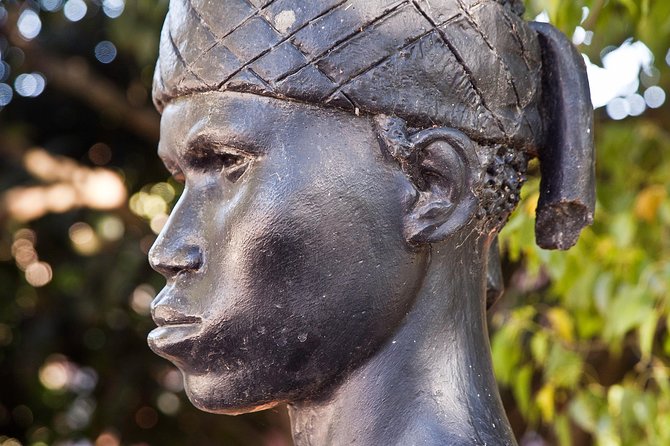
Jardim da Praça do Império was the hub of the 1940 Exhibition and receives about 20 minutes. The square still offers a broad lesson in how landscape design and public space can carry political messages.
The quick stops include the heraldic flower beds, the monumental fountain, and the seahorses. These may look like small decorative features, but that is exactly why they matter. The exhibition’s message did not come only from its grand buildings. It was repeated through symbols, patterns, plantings, and carefully ordered views.
I like this part of the tour because it makes the politics visible in ordinary details. You learn to look at the square as a designed public statement, not just as an open space near the river.
The 1940 Exhibition took place while much of Europe was at war and authoritarian governments were using architecture and public ceremony to shape national identity. Portugal presented itself as stable and timeless. The walk explains how that image concealed repression, poverty, colonial conflict, and strict social roles.
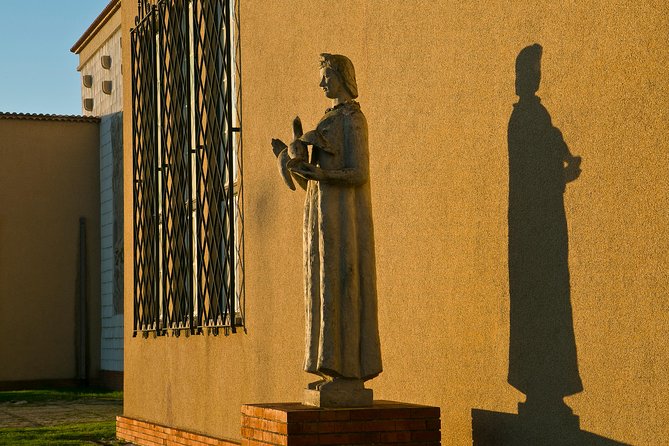
One detail connected with the exhibition is especially revealing. The government misrepresented the contribution of ten female artists because it preferred to present Portuguese women mainly as homemakers. That small fact shows how the event promoted a social order as well as a national story.
The Discoveries Monument and its carved figures
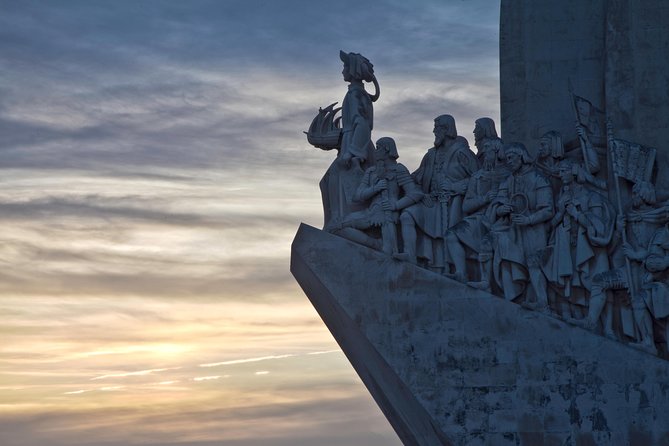
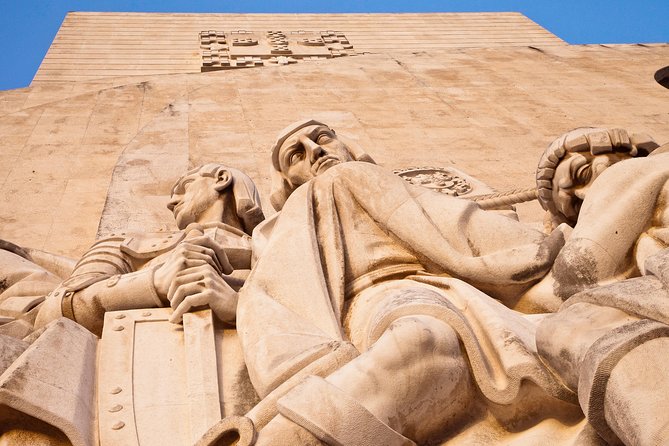
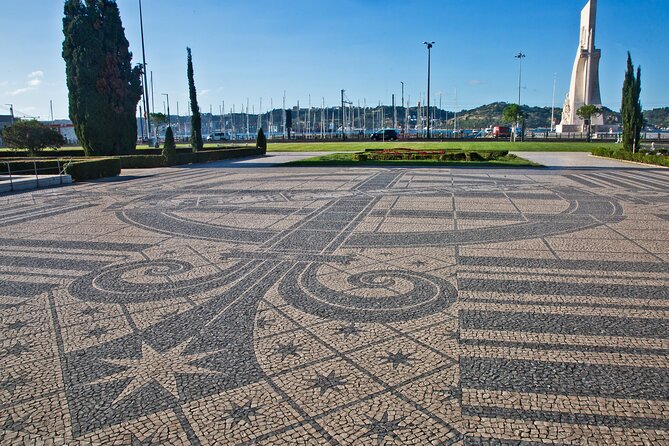
The Padrão dos Descobrimentos gets around 20 minutes. You walk around the monument, examine its figures, and look down at the large wind rose spread across the pavement.
This is the place where a guide’s preparation can save you from seeing only a dramatic profile against the river. The monument’s carved figures represent people connected with Portugal’s maritime expansion, but the identities and political choices behind that lineup are not always explained on site.
You can ask who is included, who is missing, and why the monument became such a central image of the 1940 Exhibition. Its design presents an organized procession toward the future, led by figures from the Age of Discoveries. The effect is powerful, but it is also a carefully chosen version of the past.
The pavement wind rose adds another layer. It helps place Portuguese exploration on a global map, turning the ground itself into part of the message. The guide’s job here is not simply to list names. It is to explain how geography, memory, and national pride were built into the visitor experience.
This stop should suit anyone who wants context for the monument before taking photographs. If you prefer a fast highlights tour, 20 minutes of discussion may feel long. One less enthusiastic experience came from a visitor who wanted more attention on the major sights and less time on subjects that did not match their interests. A private booking gives you the best chance of avoiding that mismatch, but tell the guide what you want at the start.
The Popular Art Museum, an odd piece of modern Lisbon
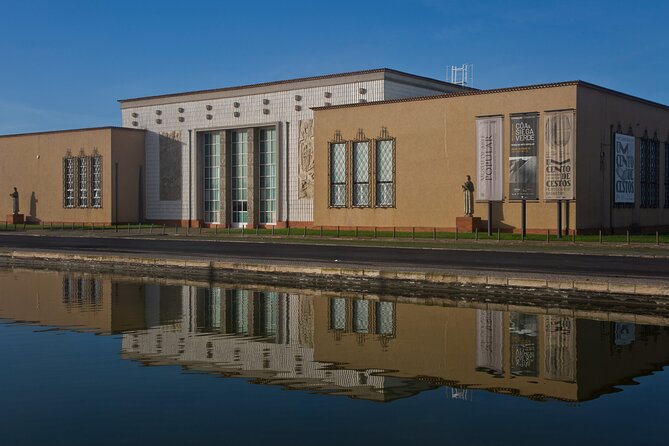
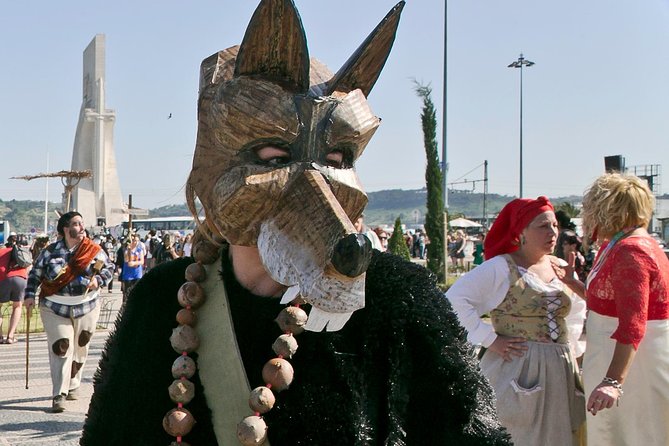
The Museu de Arte Popular receives only about 10 minutes, but it may be one of the more unusual stops. The museum is described as a puzzle and an oddity of Modernist Lisbon.
That short visit works as a reminder that the 1940 Exhibition was not only about monumental national heroes. It also tried to define what counted as authentic Portuguese culture, including folk traditions, regional identity, and approved images of ordinary life.
The museum’s role can be difficult to grasp without explanation. Its architecture and purpose sit between art, political display, and cultural classification. You might find this stop especially useful if you want to understand how governments turn local customs into national symbols.
Do not expect a full museum visit during the walk. The time is brief, and the tour remains focused on the outdoor story of Belém.
Belém Tower Garden and the route’s final contrast
The final stop is Belém Tower Garden, near the tower itself and the former Restelo upper-class neighborhood that developed after the 1940 Exhibition. The planned time is about 15 minutes.
Belém Tower is the other major monument of Portugal’s maritime age. Like Jerónimos Monastery, it predates Salazar, but it was placed within a modern political setting that used the discoveries era to support the regime’s preferred image of Portugal.
Ending here creates a useful contrast. You begin with the district’s older imperial symbols and finish with the later neighborhood and exhibition-era changes that made modern Belém look the way it does.
The end point is Belém Tower Garden on Avenida Brasília. The tower is not far from Algés train, tram, and bus stations, which gives you a practical choice after the tour. You can continue sightseeing, find food, or use public transport to return elsewhere in Lisbon.
The guide’s style and the value of a private group
The strongest part of this experience is the guide. Luís Maio is repeatedly praised for his preparation, patience, historical command, and ability to adjust the material to the group.
That does not mean the walk is a scripted private lecture. Luís has asked visitors about their interests, changed the balance of topics, found shade on hot days, and chosen places where people could sit rather than listen while standing. He has also continued in difficult conditions, including heavy rain and a storm.
His use of photographs and images from different periods is another advantage. Belém’s political past is not always obvious from the surviving buildings, so visual material helps you compare the exhibition era with the present.
The minimum booking is two people, and only your group participates. A private tour costs $33.55 per person, with group discounts available. For three hours with a local professional guide who also works as a photographer guide, I consider that a reasonable price, especially if you are curious about the political meaning of Lisbon’s monuments.
The value drops if you want only a quick introduction to Belém. You are paying for explanation and conversation, not simply transport between landmarks. Ask questions, say what you already know, and tell Luís if you want more dictatorship, architecture, religious history, or photography.
The phrase photographer guide should not be read as a promise of a separate professional photo shoot. The experience includes a guide with photographic expertise and plenty of photo opportunities along the route.
Timing, comfort, and what to bring
You can choose a morning or afternoon departure. Morning may feel easier in warm weather, while an afternoon walk gives you the option of staying in Belém afterward for indoor visits.
Wear comfortable walking shoes. The route is spread across the district, and the duration is about three hours. Smart-casual dress is requested, and you should prepare for changing weather because the experience requires good conditions.
Bring water and weather protection, even though food and drinks are not included. The guide has paid attention to shade, sun, seating, and temperature for past groups, but personal preparation still matters.
The tour is near public transportation, and service animals are allowed. Hotel pickup, hotel drop-off, and transportation to or from attractions are not included. A parking fee, if applicable, is also separate.
Free cancellation is available up to 24 hours before the start time for a full refund. Changes or cancellations made later are not accepted for a refund, and the local cut-off time applies. If poor weather causes the tour to be canceled, you are offered another date or a full refund.
Who should book this experience?
I would choose this walk if you want to understand what Belém is saying, not just photograph it. It is a strong fit for history buffs, architecture fans, politically curious visitors, and anyone who has already seen Lisbon’s main sights but still feels that the Salazar years are missing from the city’s public story.
It also suits couples, friends, and families who prefer a private conversation to a large group. Visitors with a connection to another country’s authoritarian past may find Luís’s comparative approach especially helpful.
I would be more cautious if you have limited time in Lisbon and need to enter several attractions during the same three hours. Since the main sites require separate visits, plan at least part of another day for Jerónimos Monastery, museums, or Belém Tower.
If you want to continue the subject after the walk, the Museum of the Resistance in Alfama was specifically suggested as a useful follow-up for people interested in fascism and its collapse. That pairing gives you both the public spectacle in Belém and a more direct look at repression.
Should you book the Belém dictatorship tour?
Book it if you want a thoughtful, personal explanation of the district’s monuments and the 1940 Exhibition. The 4.9 rating, 98 percent recommendation rate, and repeated praise for Luís’s preparation, flexibility, and care match the experience’s main strength: a well-informed guide who can turn overlooked details into a coherent story.
Skip it if you want an admission-based sightseeing tour or a quick checklist of Belém’s famous buildings. For everyone else, $33.55 is fair value for three hours of private guiding, especially when you use the walk as a foundation for your own monastery and museum visits afterward.
FAQ
How long is the Belém and Salazar dictatorship walking tour?
The tour lasts approximately three hours.
Where does the tour start?
It starts at Belém River Station on Avenida Brasília, 1300-598 Lisbon.
Where does the tour finish?
It finishes at Belém Tower Garden on Avenida Brasília, 1400-038 Lisbon.
Is this a private tour?
Yes. Only your group participates in the private activity.
How many people are needed to book?
A minimum of two people is required per booking.
Is the tour offered in English?
Yes. English is the listed tour language.
Are morning and afternoon departures available?
Yes. You can choose a morning or afternoon departure.
Are entry tickets to the monastery and museums included?
The tour includes a professional guide and private walking tour, but food, drinks, transportation, and separate attraction admission are not included. Plan extra time if you want to enter the monastery or museums.
What happens if the weather is poor?
The experience requires good weather. If it is canceled because of poor conditions, you will be offered another date or a full refund.
Recently added in Lisbon
- Lisbon Cinematic Photoshoot with Top-Rated Photographer★ 5.0 · 76 reviews
- City Centre Run in Lisbon★ 5.0 · 164 reviews
- City of Neighborhoods Tour 1H 30M Private Tour by Tuk Tuk★ 5.0 · 38 reviews
- Central Lisbon E-Bike Tour★ 5.0 · 168 reviews
- Hands on Portuguese Cooking Class in Lisbon★ 5.0 · 136 reviews
- Lisbon Sailing Catamaran Public Cruise with drinks★ 5.0 · 304 reviews
- Lisbon City Tour by Tuk Tuk★ 4.5 · 137 reviews
- Romantic Private Sailboat in Lisbon for couples★ 5.0 · 38 reviews
Walking Tours, compared.
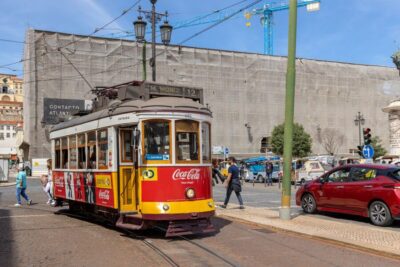

Best of Lisbon Small-Group Guided Walking Tour
Read our review →
Porto Walking Tour, Lello Bookshop, River Cruise and Cable Car
Read our review →

Best of Lisbon Walking Tour: Rossio, Chiado & Alfama
Read our review →
Experience Porto’s Charm: 3-Hour Guided Walking Tour
Read our review →
Enjoy a Guided Levada Walk in the Rabaçal Valley
Read our review →Browse the lists this tour appears in