REVIEW · LISBON TOURS
Discover Bairro Alto’s Hidden Gems and Stunning Viewpoints
Lisbon reveals itself one hill at a time. This 2.5-hour walking tour links Rossio, the ornate Rossio Train Station, Camões Square, Bairro Alto, and the Carmo ruins in a compact route through the city’s past. I like the way it mixes famous sights with useful background on the 1755 earthquake, Portugal’s national poet, and the growth of Bairro Alto.
I also like the low advertised price and the fact that a local guide leads the walk in English. The main point to watch is the €10 to €20 guide contribution, which is not included in the listed $3.61 price. The route also needs a little clarification: Largo do Carmo is described as the final historic stop, while the stated end point is Miradouro de Santa Catarina.
In This Review
- Five things to know before you book
- Starting among statues and city traffic at Rossio
- Rossio Train Station and its unusual horseshoe doors
- Luís de Camões and the story behind the square
- Bairro Alto, from plague cemetery to city quarter
- Largo do Carmo and the vow behind the convent
- The final viewpoint and an important route detail
- What the price really means
- Who will get the most from this walk?
- Should you book Discover Bairro Alto’s Hidden Gems?
- FAQ
- How long does the tour last?
- Where does the tour begin?
- Where does the tour end?
- What language is the tour offered in?
- Is transportation included?
- Is admission to the Santa Justa elevator included?
- Is a guide contribution required?
- Can I cancel for a full refund?
Five things to know before you book
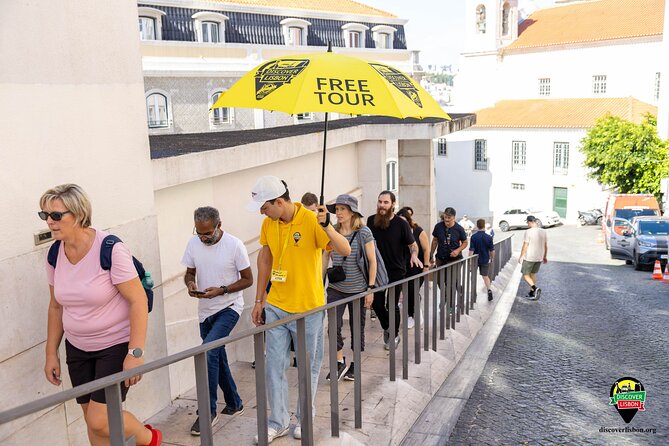
- Rossio is your starting point: You begin at Praça Dom Pedro IV, one of central Lisbon’s key squares.
- Rossio Station is a major photo stop: Its Neo-Manueline façade looks more like a grand ceremonial building than a railway station.
- Camões gives the walk literary weight: You learn about Luís de Camões, Portugal’s national poet and author of Os Lusíadas.
- Bairro Alto comes with serious social history: The guide explains how plague, population growth, religion, and urban planning shaped the district.
- The advertised price is not the full expected cost: Add the suggested contribution of €10 to €20 per person.
- The route is best for walkers: You need moderate physical fitness, and the group can include up to 50 people.
Starting among statues and city traffic at Rossio
The tour begins at Praça Dom Pedro IV, usually called Rossio. This is a sensible place to start because it puts you in the middle of Lisbon’s historic core, with streets and squares branching in several directions.
The square is more than a meeting point. It is the kind of place where Lisbon’s daily life gathers around a grand civic setting. You can use the opening 25 minutes to get your bearings and listen for the guide’s explanation of how the route connects the lower city with Bairro Alto.
I like starting here rather than meeting at a remote neighborhood corner. Rossio is easy to identify, close to public transportation, and useful for your own Lisbon plans after the walk. If you are arriving with luggage, however, remember that this is a walking experience, not a transfer service. Private transportation is not included.
The guide also places the wider story of Lisbon in view. The walk includes discussion of past destruction, especially the earthquake and its effect on the city. That context matters because many Lisbon streets and buildings make more sense once you understand how much of the city had to be rebuilt.
A few more Lisbon options side by side
- Lisbon City Center Tour – The Unmissable Lisbon
★ 5.0 · 22,234 reviews - Lisbon: Sintra, Pena, Regaleira, Cabo da Roca & Cascais
★ 4.7 · 19,656 reviews - Lisbon: Jerónimos Monastery Entrance Ticket
★ 4.1 · 14,164 reviews
Rossio Train Station and its unusual horseshoe doors
From the square, the route reaches Estação do Rossio. Allow about 25 minutes here. You do not need a train ticket or an admission ticket to appreciate the exterior, which is the real attraction described on this walk.
The station was commissioned by the Portuguese Royal Railway Company and designed by José Luís Monteiro between 1886 and 1887. It opened in 1890 and connected Lisbon with Sintra. Even if you are not taking that train, the building gives you a quick lesson in the late 19th-century Portuguese taste for historic revival styles.
The Neo-Manueline design recreates the elaborate Manueline style associated with early 16th-century Portugal. The detail to look for is the pair of intertwined horseshoe-shaped entrances. They carry the words Central Station and give the façade an almost theatrical quality.
I find this stop especially useful for visitors who might otherwise walk past the station on the way to somewhere else. From the outside, it can look more like a ceremonial monument or temple than a place for commuter trains. A guide can point out why that effect was deliberate and explain the connection between architecture, national identity, and Portugal’s age of discovery.
The drawback is simple: this is an exterior stop. You should not expect a long station visit or a railway-focused tour. The value comes from the explanation and the chance to notice details you might miss on your own.
Luís de Camões and the story behind the square
The walk continues to Praça Luís de Camões, with about 30 minutes devoted to the square and its namesake. Luís de Camões is Portugal’s national poet, best known for Os Lusíadas, the epic poem about Vasco da Gama’s sea route to India.
The guide explains how important Camões remains to Portuguese culture. His influence is so strong that Portuguese is sometimes called the language of Camões. You also hear the traditional account that he lost one eye in battle at Ceuta.
This is one of the tour’s better stops for understanding Portugal beyond its buildings. Lisbon is often presented through tiled façades, viewpoints, and seafood, but Camões brings in language, poetry, empire, and national memory. I like that the tour does not treat the square as just another place to take a photograph.
The information here is also easy to carry with you. Once you know who Camões was, references to him around Portugal become easier to recognize. The stop gives a cultural purpose to a name you may see on maps, statues, and street signs.
The tour is conducted in English, which makes this section accessible if you want historical context without having to translate a long speech in your head. Since the group may include as many as 50 people, standing close enough to hear the guide may matter, particularly in a busy square.
Bairro Alto, from plague cemetery to city quarter
The next 30 minutes focus on Bairro Alto. This is where the walk shifts from individual monuments to the forces that shaped an entire neighborhood.
In the late 15th century, Lisbon was growing crowded as people arrived from different parts of the world during the period of overseas expansion. The city needed more room. The area around what is now Camões Square once marked an entrance to Lisbon, with the Fernandine wall and the Santa Catarina gate nearby.
The story then turns to disease and social change. Land on the other side of the wall belonged to wealthy noble families, while a cemetery for victims of the Black Death occupied the hill. In 1506, King Manuel I requested a relic of Saint Roch from Venice and placed it in a hermitage near the cemetery.
As the population increased and plague returned, poorer residents and sick people moved closer to the church. An urban plan was then developed to house them. This gives Bairro Alto a much more complicated past than its modern nightlife reputation suggests.
I value this part of the tour because it explains why neighborhoods often grow in layers. Religious buildings, public health fears, noble land, and housing needs all affected the shape of Bairro Alto. You are not simply walking through a popular district. You are following the practical decisions that made the district possible.
The route is also a reminder that Lisbon is hilly. You should expect a moderate level of exertion, and comfortable shoes are a sensible choice. The tour data does not give a precise accessibility assessment, so anyone with mobility concerns should ask the provider for current route details before booking.
Same corner of the country, a different pace:
- Lisbon: History, Stories and Lifestyle Walking Tour
★ 4.8 · 10,902 reviews - Lisbon: Sunset Boat Party Cruise with DJ and Open Bar
★ 4.5 · 10,378 reviews - Lisbon: Pena Palace, Sintra, Cabo da Roca, & Cascais Daytrip
★ 4.7 · 9,981 reviews - Lisbon: Oceanário de Lisboa Entrance Ticket
★ 4.6 · 9,943 reviews
Largo do Carmo and the vow behind the convent
The listed historic route reaches Largo do Carmo, where the Carmelite church and convent carry one of Lisbon’s most memorable foundation stories. The complex was commissioned after Nuno Álvares Pereira, a general helping King John fight Castilian troops, made a vow during the 1385 Battle of Aljubarrota.
He promised to build the world’s most beautiful church if the Portuguese won. Portugal was victorious, and Pereira funded the Carmelite church and convent. Construction was completed in 1423. He then joined the Carmelite order and spent the remainder of his life there.
That story makes the stop more than an architectural pause. You get a link between military history, religious devotion, royal politics, and personal obligation. It is also a good example of how grand medieval buildings often began with a vow or act of patronage rather than a simple civic plan.
The tour includes historical facts and lighter stories about Lisbon’s famous monuments. That balance should suit you if you want more than dates, but do not want a full academic lecture. The stated visit here lasts about 15 minutes, so expect a focused explanation rather than a long interior visit.
Entry fees are not listed for the Carmelite site, and the tour includes no general admission tickets. If you want to go inside any attraction, confirm what is covered before the walk begins. The Santa Justa elevator is specifically excluded, so you should budget separately for it if that is part of your Lisbon plans.
The final viewpoint and an important route detail
The end point is given as Miradouro de Santa Catarina, a viewpoint at Largo de Santa Catarina. This is a fitting finish for a walk built around hills, neighborhoods, and changes in the city’s shape. You can use the final location to pause and take in the setting after the historical explanations.
There is one practical inconsistency in the supplied route information. Largo do Carmo is described as the final stop, but Miradouro de Santa Catarina is listed as the official end point. These places are not the same, so I would confirm the exact finishing location with Discover Lisbon before you set your plans for the rest of the day.
That matters if you are meeting someone, carrying shopping, or trying to reach a timed reservation. The tour also offers discounts for booking other experiences later that day or evening, but no details are provided about the discount amount or the other activities. Ask the guide for the terms rather than counting on a particular saving.
What the price really means
At $3.61 per person, the advertised price looks exceptionally low for a guided walk lasting roughly two and a half hours. But the experience includes a suggested guide contribution of €10 to €20, so you should treat that contribution as part of the expected cost.
Even at the higher end, the price can be fair if you want a structured introduction to central Lisbon. You receive a local guide, English-language commentary, cultural and historical background, information about the earthquake, and explanations of major monuments. There are no private transportation costs, and the main stops have no admission charge.
The value depends on what you want. If you prefer to move at your own pace and read about buildings yourself, you may find the group format unnecessary. If you want a local person to connect Rossio, Camões, Bairro Alto, and Carmo into one story, the contribution may be worthwhile.
A 4.9 out of 5 rating from 53 ratings, along with a 100 percent recommendation figure, gives the experience a strong record. Still, the group limit of 50 means this may feel more like a large public walk than a private conversation. Ask where the group gathers and how the guide handles a full group if you prefer a quieter tour.
Who will get the most from this walk?
I would choose this experience for a first or second day in Lisbon. It introduces several central areas at once and gives you useful background before you explore them alone.
It should suit you if you:
- Want an English-language introduction to Lisbon’s history
- Enjoy walking between major sights rather than riding in a vehicle
- Are curious about the 1755 earthquake and earlier destruction
- Want context for Portuguese culture, Camões, and the age of discovery
- Prefer a low-cost group tour
- Can manage a moderate amount of walking and Lisbon’s hills
You may want another option if you need a small private group, guaranteed step-free access, or extensive interior visits. This experience is built around streets, squares, façades, and guided explanation. Its strength is the connected story, not a long stay inside one monument.
Service animals are allowed, and the route is near public transportation. Confirmation is provided at booking. Free cancellation is available until 24 hours before the start time, which gives you some flexibility if your Lisbon plans change.
Should you book Discover Bairro Alto’s Hidden Gems?
I would book it if you want a concise, history-led walk through central Lisbon at a modest total cost. The strongest parts are Rossio Station’s remarkable façade, the explanation of Camões, and the account of how plague and population growth shaped Bairro Alto.
Before paying, remember the €10 to €20 contribution and confirm whether the walk ends at Largo do Carmo or Miradouro de Santa Catarina. If those points work for you, this is a useful orientation tour with a clear local focus and enough history to make later independent exploring more rewarding.
FAQ
How long does the tour last?
The experience lasts approximately 2 hours and 30 minutes.
Where does the tour begin?
It begins at Praça Dom Pedro IV, 1100-581 Lisboa, Portugal.
Where does the tour end?
The stated end point is Miradouro de Santa Catarina, 1200-262 Lisboa, Portugal. Largo do Carmo is also described as the final historic stop, so confirm the exact ending point before you go.
What language is the tour offered in?
The tour is offered in English.
Is transportation included?
No. Private transportation is not included. The route is near public transportation.
Is admission to the Santa Justa elevator included?
No. Entry to the Santa Justa elevator is specifically not included.
Is a guide contribution required?
A contribution of €10 to €20 per person is not included in the listed price.
Can I cancel for a full refund?
Yes. You can cancel at least 24 hours before the experience start time for a full refund. Changes or cancellations made less than 24 hours before the start time are not accepted for a refund.
Recently added in Lisbon
- Lisbon Cinematic Photoshoot with Top-Rated Photographer★ 5.0 · 76 reviews
- City Centre Run in Lisbon★ 5.0 · 164 reviews
- City of Neighborhoods Tour 1H 30M Private Tour by Tuk Tuk★ 5.0 · 38 reviews
- Central Lisbon E-Bike Tour★ 5.0 · 168 reviews
- Hands on Portuguese Cooking Class in Lisbon★ 5.0 · 136 reviews
- Lisbon Sailing Catamaran Public Cruise with drinks★ 5.0 · 304 reviews
- Lisbon City Tour by Tuk Tuk★ 4.5 · 137 reviews
- Romantic Private Sailboat in Lisbon for couples★ 5.0 · 38 reviews
Lisbon Tours, compared.
Lisbon City Center Tour – The Unmissable Lisbon
Read our review →

Sunset Boat Party Cruise with DJ and Open Bar
Read our review →
Pena Palace, Sintra, Cabo da Roca, & Cascais Daytrip
Read our review →
True 4Hour Private Tuk Tuk Tour: Discover Lisbon with a Local!
Read our review →