REVIEW · HALF-DAY
Madeira: Half-Day Coasteering Tour
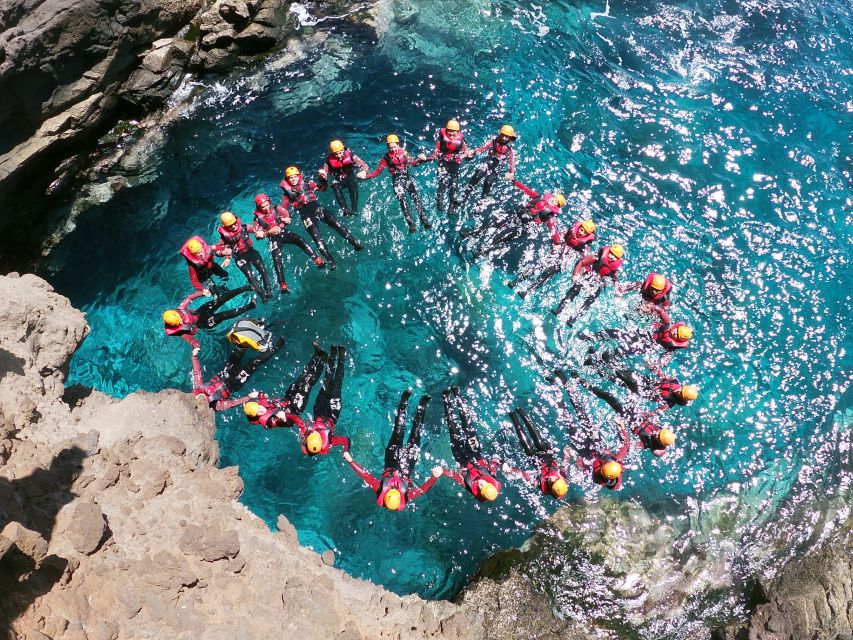
Cliffs, caves, and warm Atlantic water await. This four-hour coasteering outing takes you along Madeira’s southeast coast at Baia d’Abra near Caniçal, where volcanic rock meets clear sea. I like the mix of swimming, snorkeling, climbing, cave exploration, and optional jumps. I also like that the guides stay with you throughout, making this much less intimidating than going it alone.
The best part is the freedom to choose your own level. Jumps range from 1 to 10 meters, but every jump is optional. The main drawback is that this is a physically demanding activity, and rougher waves can affect the experience. You need to swim, manage uneven rock, and feel reasonably comfortable in open water.
In This Review
- Key points at a glance
- Madeira’s volcanic coast at Baia d’Abra
- What the four-hour outing feels like
- Choosing your cliff jump
- Caves, tunnels, and clear water
- Guides who keep the mood calm
- What the price includes at $74
- Who should book this adventure
- What to bring and how to prepare
- The main drawback: ocean conditions
- Is Madeira coasteering good value?
- Should you book the Baia d’Abra tour?
- FAQ
- How long does the coasteering tour last?
- Where does the tour take place?
- Are the cliff jumps mandatory?
- Do I need to know how to swim?
- What languages are available?
- Is pickup included?
- What should I bring?
- Who cannot take part?
Key points at a glance
- Baia d’Abra setting: Explore Madeira’s striking southeast coast inside a natural park near Caniçal.
- Optional cliff jumps: Choose from jumps between 1 and 10 meters, or skip them completely.
- More than swimming: The route can include climbing, snorkeling, caves, tunnels, and movement along rocky shore.
- Friendly safety support: Guides such as Beto, Alfonso, Alex, Diego, Felipe, and Yvonne have been praised for keeping the mood relaxed and safe.
- Useful inclusions: Pickup and drop-off, insurance, guides, first aid, photos, water, and energy bars are included.
- Best for active swimmers: The tour is suitable for adults, families, and children age 7 and older who meet the height and swimming requirements.
Madeira’s volcanic coast at Baia d’Abra
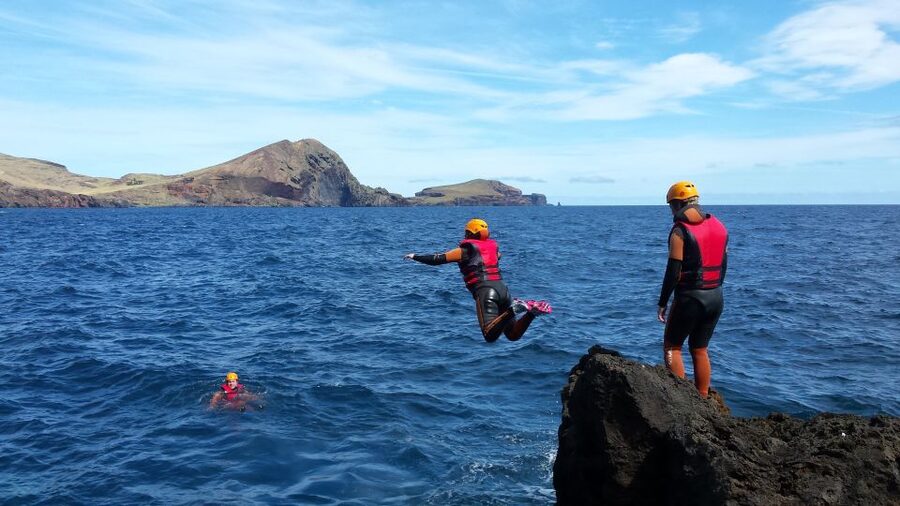
The tour takes place at Baia d’Abra, on Madeira’s southeast coast near Caniçal. This is a natural park with a rugged shore, volcanic rock, and steep mountain scenery dropping toward the sea. Instead of simply looking at the coast from a viewpoint, you move through it from water level.
That change in perspective is the real appeal. You may swim beside dark rock, pass through sea caves, climb over sections of shoreline, and look back at the mountains from the water. The setting is not a sandy beach outing. It is a rougher, more active way to meet Madeira’s coastline.
The water is described as clear and warm, though sea conditions can change. One four-star assessment noted that larger waves made the activity less enjoyable than it might have been on a calmer day. That is useful to keep in mind: coasteering depends partly on the ocean, so the same route can feel gentle one day and more demanding the next.
A few more Madeira options side by side
- From Funchal: Ecological Catamaran Dolphin Whale Watching
★ 4.5 · 5,771 reviews - Madeira: Skywalk, Porto Moniz, Seixal, and Fanal 4WD Tour
★ 4.9 · 5,732 reviews - Funchal: Dolphin and Whale Watching Catamaran Cruise
★ 4.5 · 5,697 reviews
What the four-hour outing feels like
This is a half-day activity, with starting times available when you book. Pickup and drop-off are included for visitors staying in Funchal. You should wait in your hotel lobby 30 minutes before the scheduled pickup, and the driver carries a sign with your last name. The driver waits no longer than 15 minutes after the planned pickup time, so do not cut it close.
After transport to the coast, the guides lead you through the safety procedures and help with the equipment. You are asked to provide your height, weight, and shoe size in advance. That information matters because the right fit makes movement over wet rock and through the water much easier.
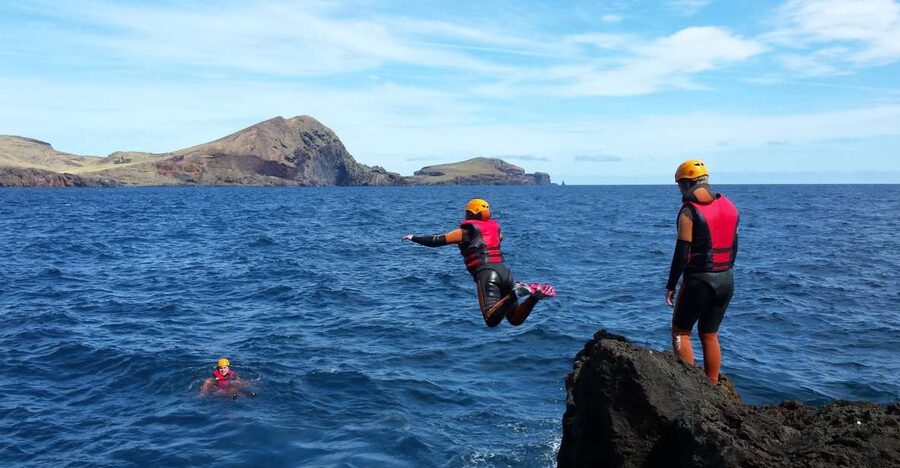
The route combines several kinds of movement rather than repeating one trick. You might swim between rocky sections, climb along the shoreline, snorkel near caves, pass through tunnels, or make a jump into the sea. The exact balance depends on the group, conditions, and how the route is managed that day.
The guides remain with the group for the full route. Their role is not just to point out where to go. They assist with safety techniques, explain procedures, and help you decide how far to push yourself. That support is especially useful when a low jump feels higher than expected or when a wet rock requires careful footing.
Choosing your cliff jump
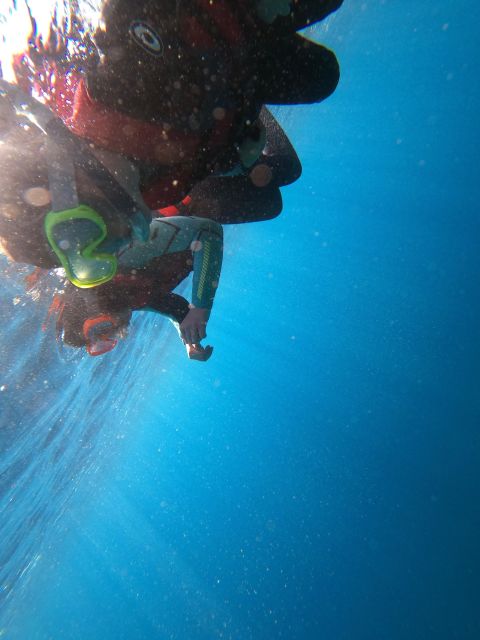
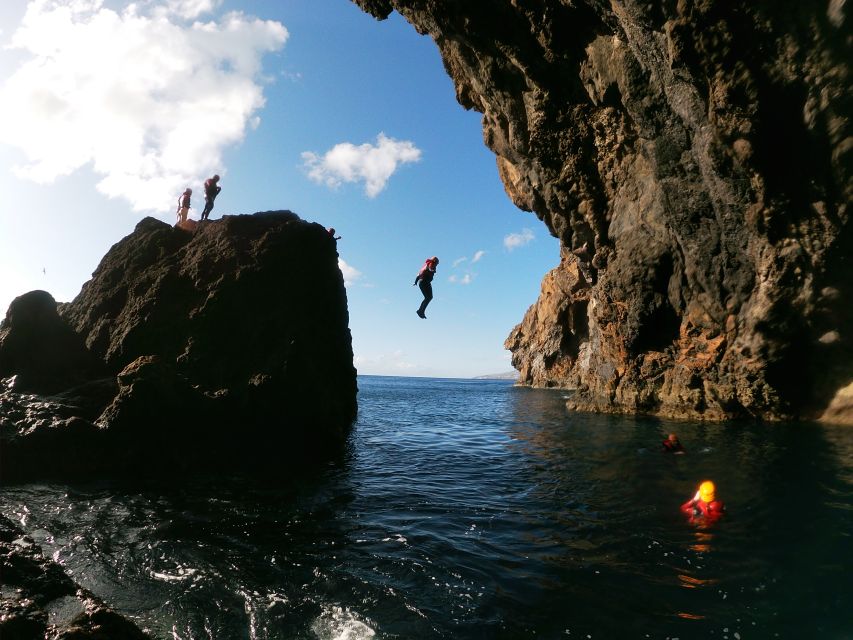
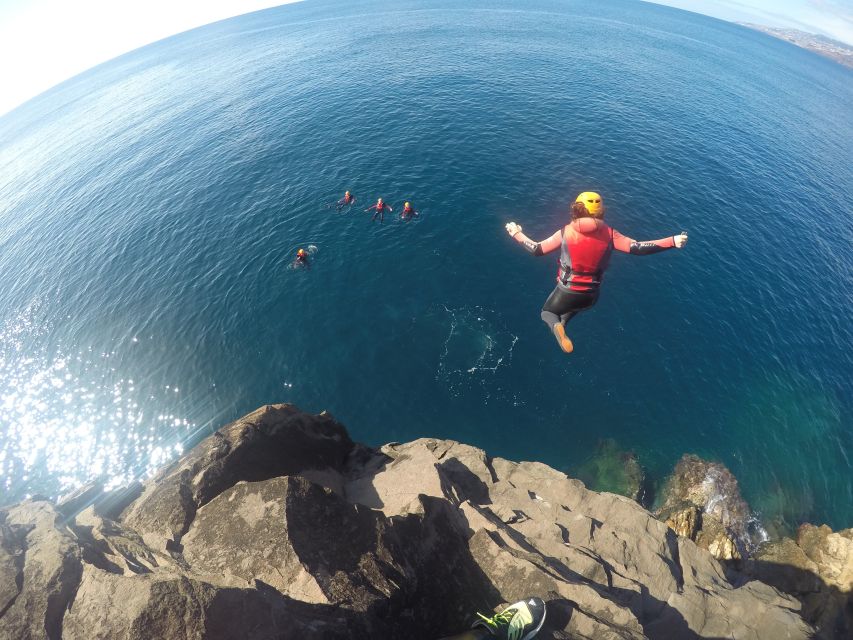
The jumps range from 1 to 10 meters, giving the activity a built-in scale of difficulty. You can start with a lower jump, watch how the water entry works, and decide from there. You do not have to complete every jump, and you can skip them entirely.
That optional approach makes the tour more approachable than the phrase coasteering might suggest. You still get the setting, swimming, caves, and rocky route even if you are not keen on launching yourself from a ledge. On the other hand, if cliff jumping is the main reason you are booking, the range up to 10 meters provides a real challenge.
I would advise you not to treat the highest jump as a goal you must reach. Ocean conditions, confidence, and comfort in the water matter more than proving anything. The guides can help with technique and safety, but you remain responsible for choosing the activity level that feels right.
Several participants described the jumps as exciting, slightly frightening in a good way, and highly rewarding afterward. That combination is probably the best description of the experience. It is not a passive swim. You are likely to feel a rush, but you should also expect moments when you need to pause and gather your nerve.
Caves, tunnels, and clear water
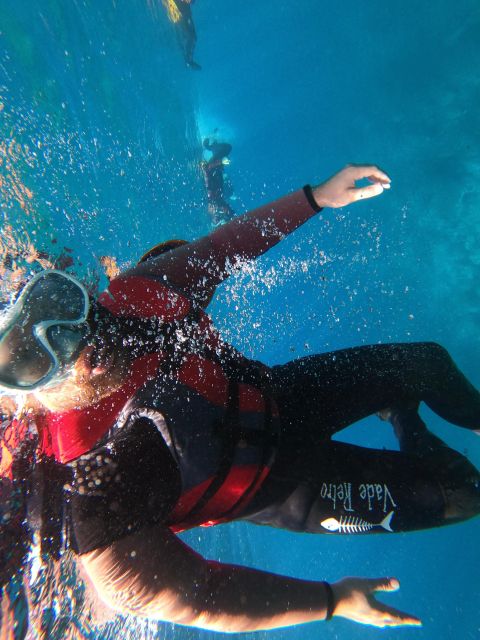
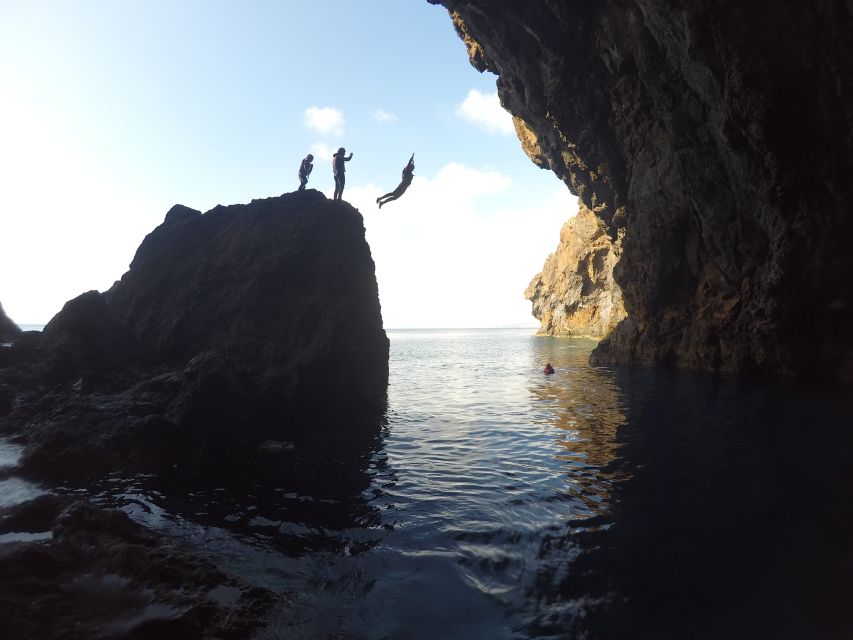
The caves add variety and give the route a sense of discovery without requiring a long boat trip or a full-day excursion. Swimming into a cave or tunnel changes the light, sound, and texture of the coast around you. Snorkeling lets you look below the surface rather than simply crossing from one rock to another.
The supplied details do not promise a particular marine life sighting, so I would not book this as a wildlife tour. Think of snorkeling as one part of a broader coastal adventure. The real value comes from combining the water, volcanic rock, caves, and movement along the shore.
Clear water helps in practical ways, too. It can make the route feel less uncertain when you are approaching a rock or preparing for a jump. You can better see where the water meets the shoreline, although you still need to follow the guides and use care around rocks.
Madeira’s coast is shaped by lava and rock rather than soft, level ground. That gives the area its character, but it also explains why this activity is not recommended for people with limited mobility. You need to climb, swim, move across uneven surfaces, and handle transitions between land and sea.
Same corner of the country, a different pace:
- Funchal: Enchanted Terraces, Porto do Moniz & Fanal 4WD Tour
★ 4.8 · 4,930 reviews - Porto Moniz, Seixal, Fanal Forest, Cliff Skywalk in Open Roof 4X4
★ 5.0 · 3,631 reviews - From Funchal: Best of Madeira’s West Tour
★ 4.7 · 3,463 reviews - Madeira: Best of the East Tour from Funchal
★ 4.7 · 3,364 reviews
Guides who keep the mood calm
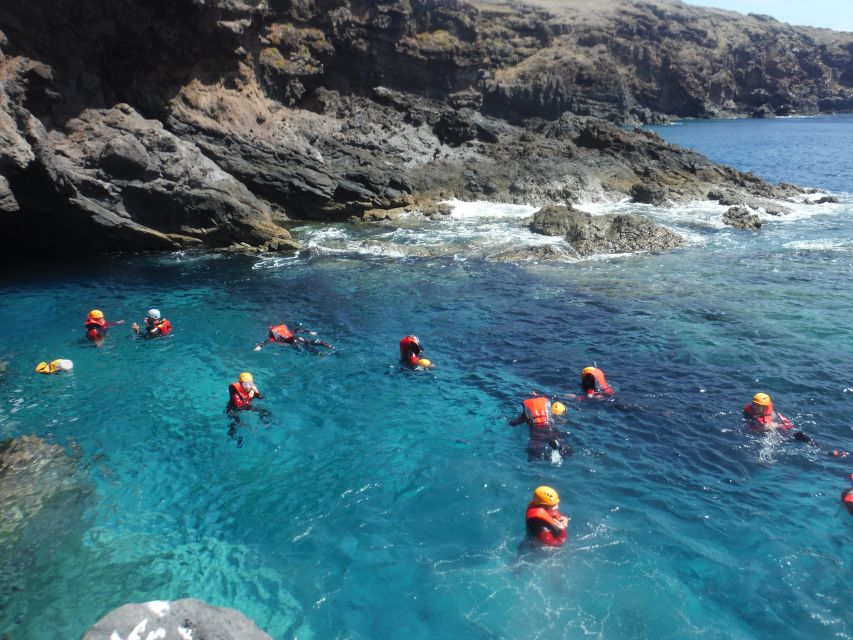
The guide team receives some of the strongest praise connected with this experience. Beto, Alfonso, Alex, Diego, Felipe, and Yvonne are specifically named in the feedback, with repeated comments about their friendliness, humor, and ability to make the outing feel safe.
That matters because a coasteering guide has two jobs. The first is technical: explain procedures, help with safety, and keep the group moving. The second is emotional: help you stay relaxed when a jump, swim, or climb feels more serious than expected.
The guides appear to do both well. Several comments describe the activity as intense but still fun and easygoing. One couple particularly appreciated being helped when needed without losing the chance to take part fully. That is the right balance for this kind of tour. You want assistance, not someone taking over every decision.
Good guides also make a difference for mixed groups. Families, friends, and individuals may arrive with very different comfort levels. Since jumps are optional, the activity can accommodate those differences better than a fixed challenge where everyone must complete the same obstacle.
What the price includes at $74
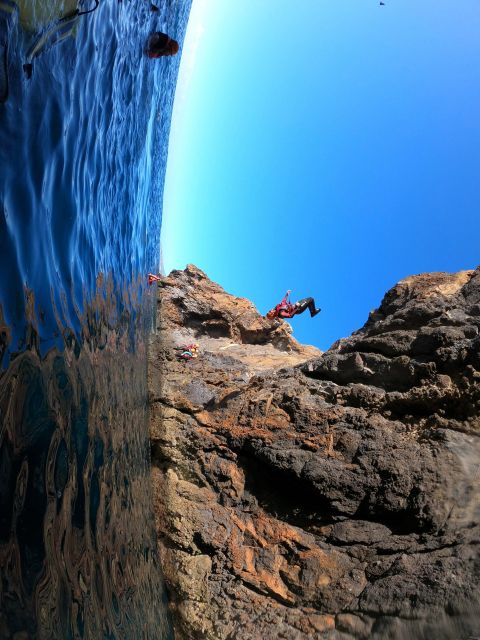
At $74 per person, this is not simply a swim at the beach. The price includes a four-hour guided activity, pickup and drop-off, photos, water, energy bars, insurance under Portuguese law, first aid, and guide support.
The photos are a useful inclusion. During a coasteering route, you cannot safely carry a camera through every climb and jump. Having photos taken lets you keep a record without turning your phone into another piece of equipment to worry about.
The included transport also adds value if you are staying in Funchal. You avoid arranging your own route to Baia d’Abra, and the day has a clear beginning and end. Pickup outside Funchal costs an additional 15 euros per person, so check your hotel location before you compare the final price with other activities.
Water and energy bars are modest inclusions, but they fit the outing. Four hours of swimming and climbing can use more energy than you expect. You should still arrive prepared, but having a small supply during the activity is helpful.
Insurance and first aid provide another layer of reassurance. They do not remove the physical risks of wet rock or open water, but they show that the activity is organized as a proper guided sport rather than an informal swim.
Who should book this adventure
This tour suits you if you can swim and want an active way to see Madeira. It is especially appealing if you enjoy a mix of challenge and scenery rather than spending half a day on a bus or at a viewpoint.
Families can take part, but children must be at least 7 years old. The minimum height is 120 centimeters, and the activity is not suitable for pregnant women or people with mobility impairments. Those restrictions are sensible given the climbing, swimming, and uneven coastal rock.
You do not need to be an expert cliff jumper. The optional nature of the jumps allows you to participate at your own pace. Still, you should be honest with yourself about swimming in the sea and moving over rough surfaces. If you dislike open water or have difficulty climbing, this may feel like work rather than recreation.
It also suits solo participants and small groups. The guides provide the structure, and the group setting can make the more nerve-racking parts easier. The friendly tone described in the feedback is a plus if you are booking alone.
What to bring and how to prepare
Bring your passport or ID card, comfortable clothes, and swimwear. The bathing suit is not provided, so pack your own. You should also give the operator your height, weight, and shoe size so the equipment can be prepared properly.
Wear something you can move in before and after the water portion. The exact equipment list is not provided, so follow the provider’s instructions about footwear and personal items. Avoid bringing anything you would be upset to lose or damage around salt water and rock.
Plan to be ready early for pickup. Waiting in the lobby 30 minutes before the scheduled time gives the driver a fair chance to find you, especially at a larger hotel. Since the vehicle waits only 15 minutes after pickup time, punctuality matters.
The tour is offered with live guides in English, German, and French. If you have concerns about your swimming ability, physical condition, or comfort with heights, raise them before the activity begins. The guides can explain the available choices, but you should not wait until you are already at a jump to mention a serious concern.
The main drawback: ocean conditions
The biggest variable is the sea. On a calm day, the route can feel playful and scenic, with clear water, cave swimming, and a comfortable rhythm between climbing and jumps. With larger waves, entries and exits from the water may feel harder, and the route can lose some of its easygoing character.
This is not a flaw unique to the operator. It is part of choosing an ocean-based activity. Still, you should understand that the experience is not fully predictable in the way an indoor attraction is.
The guides may adjust how the activity runs, but the available information does not promise a particular route or exact set of jumps. If your priority is a relaxed swim with no physical strain, choose a different Madeira outing. If you like a bit of uncertainty and can accept that the sea sets the tone, the changing conditions are part of the adventure.
Is Madeira coasteering good value?
For $74, I consider this a fair price for an active half-day, especially with Funchal pickup, photos, insurance, guides, first aid, water, and energy bars included. You are paying for instruction and access to a coastal route that would be difficult to manage safely on your own.
The value is strongest if you plan to take part in several elements: swimming, caves, snorkeling, climbing, and at least some optional jumps. If you skip every jump and spend much of the route feeling uncomfortable, the price may seem less attractive.
The strong rating of 4.9 from 131 reviews also fits the specific praise directed at the guides and the sense of safety. No activity earns that kind of response by scenery alone. Here, the human side of the tour appears to be a major part of what you are paying for.
Should you book the Baia d’Abra tour?
Book it if you want to experience Madeira from the water and enjoy a controlled dose of adventure. You will get clear sea, volcanic rock, caves, guided safety support, and a choice of jumps ranging from very manageable to genuinely high.
Skip it if you have limited mobility, cannot swim, are pregnant, or want a quiet coastal sightseeing trip. Also think twice if rough water makes you anxious. For confident swimmers who like physical activity, this is one of the more memorable ways to meet Madeira’s southeast coast, and the guides’ friendly approach makes the challenge easier to handle.
FAQ
How long does the coasteering tour last?
The activity lasts four hours. Starting times depend on availability when you book.
Where does the tour take place?
The coasteering takes place at Baia d’Abra near Caniçal, on Madeira’s southeast coast, inside a natural park.
Are the cliff jumps mandatory?
No. All jumps are optional. The available jumps range from 1 to 10 meters high.
Do I need to know how to swim?
Yes. Participants must be able to swim because the route includes swimming in the sea.
What languages are available?
Live guides are available in English, German, and French.
Is pickup included?
Pickup and drop-off are included for the standard service. Pickups outside Funchal cost an additional 15 euros per person.
What should I bring?
Bring your passport or ID card, comfortable clothing, and swimwear. You must provide your height, weight, and shoe size for the equipment.
Who cannot take part?
The activity is not suitable for children under 7, people under 120 centimeters tall, pregnant women, people with mobility impairments, or anyone unable to swim.
Recently added in Madeira
- Responsible Whales and/or Dolphins Watching Tour★ 5.0 · 237 reviews
- Adventure Trikes Private Tour in Madeira★ 5.0 · 159 reviews
- West 4×4 Experience: Skywalk, Porto Moniz Pools and Fanal Forest★ 5.0 · 49 reviews
- Small Group West Tour Waterfalls & Fanal Forest Tour★ 4.5 · 397 reviews
- Private Dolphin and Whale Watching Tour in Madeira★ 5.0 · 539 reviews
- West Madeira 4×4 Tour with Local Guide★ 5.0 · 156 reviews
- Dolphin – Whale – Turtle – Bird Watching★ 5.0 · 350 reviews
- West Side Private Full Day Tours around Madeira Island★ 5.0 · 274 reviews
Half-Day, compared.
São Miguel Azores: Half-Day Whale Watching Trip
Read our review →

Sintra Half-Day Private Tour – A Journey through Wonderland
Read our review →